
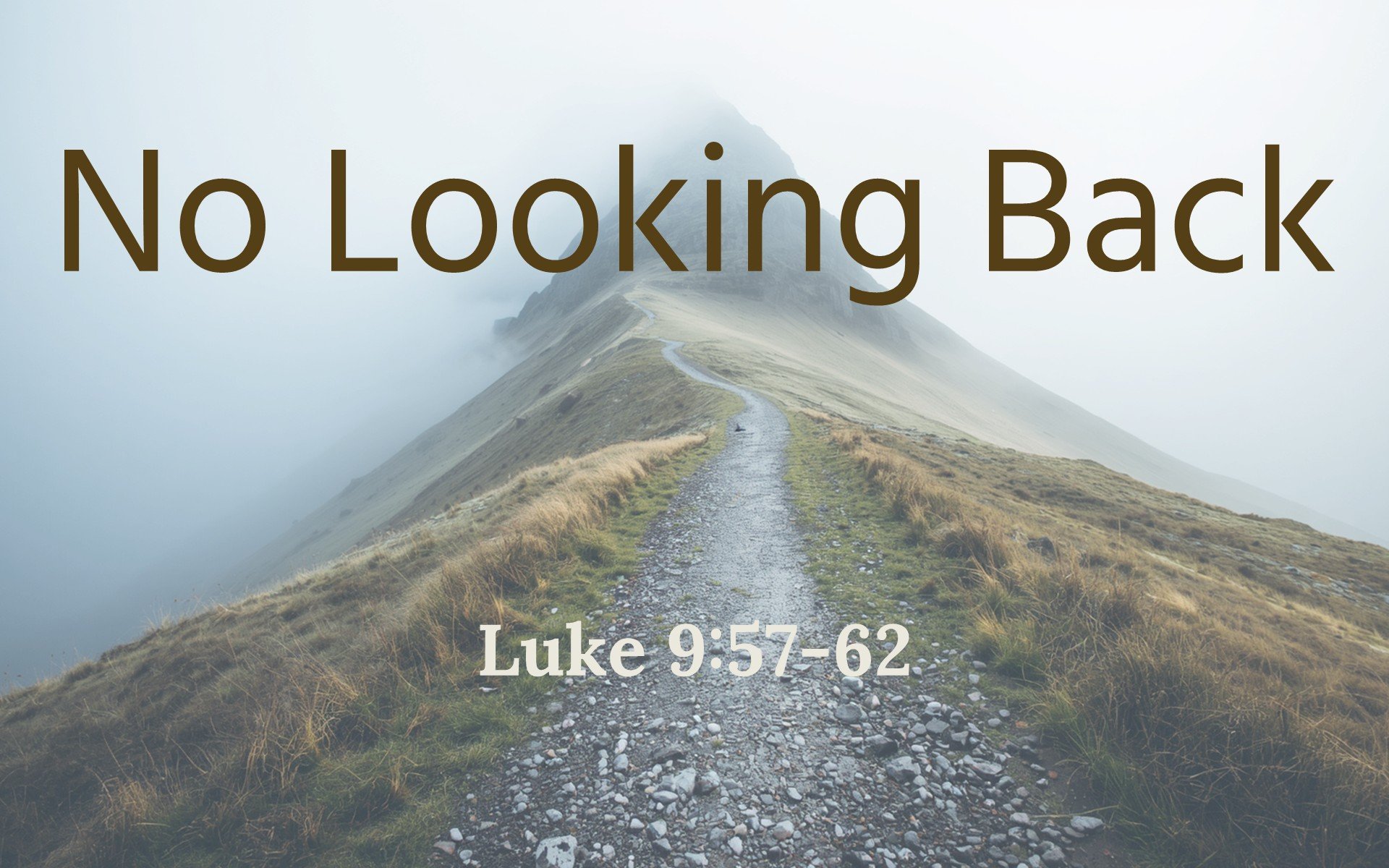
The earliest followers of Jesus weren't called Christians. They were called people of the Way because following Jesus wasn't a belief system or a religion, it was a road you walked. But before you ever step foot on the road that follows Jesus, he is the first to tell you that the commitment is all-encompassing.
What We'll Cover:
Why the earliest followers of Jesus were called people of the Way and what that means for us today
The culture of non-commitment all around us, and why it's costing us more than we realize
What Jesus said about the cost of following
What real commitment looks like when it's lived out
How coming to the communion table is a renewal of the most important vow you'll ever make
Catch the weekly sermon here or on our SRBC podcast on Apple Podcast and Spotify.
-
No Looking Back — Sermon Transcript
South Run Baptist Church | Springfield, VA
Pastor Eric Gilchrest
Luke 9:57–62; 1 Kings 19:19–21
This is a full sermon transcript from South Run Baptist Church in Springfield, Virginia. In this message, Pastor Eric Gilchrest preaches on the cost of discipleship from Luke 9:57–62 and 1 Kings 19:19–21. This sermon launches the "The Jesus Way" series and addresses the decline of commitment in modern life, what it truly means to follow Jesus on the narrow road, and why communion is a renewal of the covenant vow of baptism.
Getting Lost Without a Map
Good morning. Good morning. I was trying to pinpoint when this story took place. I think it was like 1996 or 1997, because I hadn't yet moved to Kentucky, which took place summer of 1997, but I was driving, which means it had to be at least 1996 or thereafter. I was about 16 or 17 years old. Google had not yet been invented, nor had your iPhone. We did not have maps on our phones, but we didn't even have the GPS systems. If you were old enough, you sat the GPS in your car, the Garmin, before there was the Google Maps on your phone. And so the old school way was to get a map out and to kind of route your route ahead of time, right? And so you know where you're going.
Well, as a 16-year-old, I still didn't know street names. My parents had been driving me everywhere. I'm sure it's not too dissimilar still. You kind of know your way. You more feel around than you do actually like know the streets. So I was trying to impress a girl. She invited me to a dance event. I don't even remember what the event was. But she invited me and I wanted to be there. And so I had not done the proper thing in 1996 or 7, where you look ahead of time at the map and you find where to go. And I did what I do so many times in life to this very day, which is I just jumped in the car and I went.
And I was probably 30 minutes in and I'm just kind of driving around at this point. And I was lost. It's somewhat miraculous that I actually made it back to my home, but I kept driving. I probably drove around for a good hour and a half, and I finally looked at the clock, and I said, well, I'm not gonna make it in time. The punchline of this is, of course, that the girl was not impressed. And I was lost. And I wished I had a guide, right? A GPS or a Google Maps to show me the way. And I did not.
Launching "The Jesus Way" Series: The Narrow Road and the Broad Road
This morning, we're launching something new. We're talking about the Jesus way. And if you were here last week for Easter, I brought up the mental models of like there's the immediate path and there's the long-term walking of the path. But there's two paths, right? There's the narrow and there's the broad. And my hope for these next weeks that are coming here is for me to be a guide, to show you how to read your guide and in order to walk the path that is meant to be walked by Jesus going before us. And then also, like, how to stay off that other path that we are not to be on. And so we will alternate back and forth and back and forth, again, hoping for me to be something of a guide to you in walking the narrow Jesus way.
Before we get started today, though, I do want us to pray together, and we'll launch in.
Heavenly Father, we come this morning, and we do need a guide. And as much as I'd love to be one, I need a guide. We need Jesus. We need the Holy Spirit directing us here and now. Heavenly Father, we need you. And so we ask in this moment, Lord, that you pierce the veil that sits on all of our hearts, that you tear it away, and that you be moving in clear and mighty ways in each and every one of us. Lord, each of us is here for a reason. We are in this room for a reason. We are listening to this for a reason. And God, we ask that you move in a mighty way to reveal that to us. We pray this in Christ's holy name. Amen.
America's Commitment Problem: College Sports, Marriage, and the Rise of the "Nones"
So we are indeed talking about the two paths. We are for a while, and this week we are starting the journey together, so to speak, and any good journey starts with the first steps. And if you know your Bible well enough, then you know that Jesus actually multiple times comes to people and he says to them, follow me, right? I want to take you on a journey. And we see this with the disciples, and we see this in today's passage as well. And so, in today's passage, I decided to go ahead and start with some of the harder things that Jesus wants to say.
I think we live in a world that has a commitment problem. I'm going to guess that you could come up with your own examples of this commitment problem. I feel like it's getting worse. Maybe it's just because I'm getting older. But I do feel we are less and less committed to certain things in life. The trivial example I came up with was college sports. If you watch college sports, then you know that there was a day and age in which somebody enrolled in college, and then they were there for four years, and you watched that player as a freshman, and then as a sophomore, as a junior, and then their senior year was really special because they had matured into this wonderful athlete who was going to lead their football team or their basketball team to victory, and it was a fun thing to watch. And then you know where this is going. No one is committed to a team anymore or a school. Like if the right donor comes along, well, freshman year might be spent at the University of Miami, and then a year later, you're over at Florida. God forbid.
Another example. There was a day and age, not that long ago, where you were committed to the place you were born into, the town. You grew up there. And there was a loyalty to the people in that town. And you knew it well. And they knew you well. And it came with its own traps, of course. But you were committed to it, right?
Or let's get real here. Religion. If you know anything about the state of religion in the world, but especially here in America, it's not looking good. For every six people that leave the Christian faith, only one comes into it. Six people leave, one comes in. You just, you know, you chart that out over enough years, and what happens? Well, along with that comes the rise of this sociological group called the nones, which is to say, N-O-N-E-S, nones. The nones are people who, well, they're not committed to any kind of faith. They believe in God probably. Not all of them do actually, but they believe in kind of something. They just don't want to commit to a certain brand. There's no brand loyalty. And so they're not so sure about the Christian God or the Muslim God or any other God that's out there. And they're just going to kind of feel their way through life. And I feel like this is a wonderfully kind of great example of the state of the nation where we don't commit to much of anything and we're just going to feel our way through life.
The Waning of Commitment in Church Life and Marriage
If I'm honest, I have noticed the lack of commitment — or maybe I should say just waning commitment — in church life generally. And I've been here eight years, and this church, for 40-some-odd years now, was built on a model of commitment and service and people who jump in and do the ministry of the church, right? Because you only pay one minister, that happens to be me, but the assumption is that there are all these other ministers out there doing the ministry as well. And there was a day and age in 1985 or 6 or 95 and 96 when that could be assumed — that everybody is committed. If you live in the United States, you're probably a Christian and you're probably going to church. And that assumption is slowly being eroded, maybe quickly now. And even over the last eight years, I'll say, I've noticed there's kind of a waning of commitment, even in our own pews. And I say this not as judgment, I'm just describing the reality that is the United States and how it makes it into our walls as well. Nobody is immune.
And lastly, my example of the waning commitment is with marriage. Marriages are increasingly non-committal. But what's interesting to me is actually divorce rates have — I don't know if you know this, I didn't know this — they've slowly tapered off. Divorce is not actually up. I remember when I was young and my preacher would always say, you know, Christian divorces are at the same rate as secular divorces, which is, I think, largely true, and it's like 50%. And that's actually tapered some. But that's not the problem. That's a good thing, obviously. The problem is the people just aren't getting married at all. People are waiting really long to get married. And there again is the commitment issue, right? It's, well, I'm gonna bide my time here and I'm gonna wait it out and I'm gonna do my own thing. I'm gonna get my career going and I'm gonna take care of me and I'm not going to commit to another person. And so even in marriages, we see this lack of commitment.
David Brooks, The Second Mountain, and the Four Commitments of a Good Life
A few years ago, a gentleman named David Brooks wrote a book called The Second Mountain in which he describes the need for four commitments in life. If you want to live a good and fulfilled life and get to the end of it all and look back and say, I lived a good life — he says, and I happen to agree — you should make at least four commitments. One is to family, another to friends, another to your vocation, what you're called to do in this life, and then of course some kind of faith community and a faith. I'm here to talk to you about the faith piece.
I actually want to launch back into marriage for a second because I think the two are tied. This is the commitment to your family or to your marriage. When I got married, or maybe right before, we did some premarital counseling, and I don't remember a lot of it, but I do remember this one analogy that whoever was doing the speaking offered, and it's just kind of stuck with me all these years. And I offer it to you, especially the younger people in our congregation, but maybe some of you old folks who need this as well.
A marriage, you might think, is the gift, like you are given a car when you say your vows, and then you are not supposed to drive this car into the ditch at some point, right? That's what marriage is, or maybe some people think so anyway. And then over time, that car maybe gets beat up, and you got to put a new tire on it, or you back it into a clump of snow by our house, and now we need a new bumper. And then you slap that on. But that's not marriage. Marriage is you come down the aisle, and there's a pastor there, and he makes you take some vows. You say, I do, and then you start something. You start a journey, like we're starting right here. And when you start that journey, you're not given a new car. You're given car parts, and you're given maybe a little bit of a map, probably a picture of what that thing's supposed to look like, and then you spend the rest of your lives building the car. This is marriage. You're building something together. You're not just handed it.
I think faith is a lot like this. Faith is a lot like marriage. When you get married, you say, till death do us part. You say, I do, and then it takes a whole lot of work the rest of your life to make and build a good marriage. And faith, it's a lifelong process of a whole lot of work saying till death do us part, and you're building something, building something in your soul. And that's what a good faith journey is. And this is the journey I'm inviting you into this morning. Many of you have already started, and I'm hoping after — well, we'll say weeks, but frankly years and decades of this — you will have built something that is good and beautiful. This is what Jesus is inviting each of us into this morning.
Luke 9:57–62: Three Would-Be Followers and the High Cost of Discipleship
But here's where it starts. Open your Bibles to Luke chapter 9, and we'll read what Jesus has to say to these three people who come to him. Starting in verse 57, he says this:
As they were going along the road, someone said to him, "I will follow you wherever you go."
And that might be you this morning. That might be you right now. And you're saying, all right, Eric, you know what? I'm already in. I am ready to follow Jesus on this narrow road. Let me show you the way. Well, I'm showing you what Jesus says to this gentleman who says to him, I will follow you. And Jesus says to him:
"Foxes have holes and birds of the air have nests, but the Son of Man has nowhere to lay his head."
Which is to say, buckle up, get ready. This journey might not be exactly what you think it is. The commitment is high, and the expectations are high, and there will be challenges along the way.
It doesn't stop there, though. Second person comes, and Jesus this time says, follow me. Same word, right? Follow. Follow me. But he says, well, Lord, let me first go and bury my father. And Jesus said to him, "Leave the dead to bury their own dead. But as for you, go and proclaim the kingdom of God." That one is pretty harsh. It sounds harsh to me, and it should sound harsh to you too.
Let's jump into the third one, and then we'll come back and grab them all together. Yet another says, I will, here again, follow you, Lord, down this narrow road — I am in. But let me first say farewell to those at my home. And Jesus said to him, "No one who puts his hand to the plow and looks back is fit for the kingdom of God."
All three of these, once again, is Jesus saying, I want you to follow me, but I want you to know the commitment level is as high as it gets, right? You should be committed to your family. David Brooks says as much in The Second Mountain. It's one of his four, right? But Jesus says there's a higher loyalty yet. And Jesus is calling us into this way, and he's saying, you know, get ready, buckle up. It's not going to be easy.
1 Kings 19: The Calling of Elisha — a Blueprint for Radical Commitment
Now, what you might miss in here is that this is actually a reference to a passage from your Old Testament. I'll just read it. It's not going to take too long. This is the calling of Elisha. Elijah and Elisha, you might remember, these two great prophets, right? And Elijah is going along and he sees Elisha, it seems, for the first time, and he's calling him to follow Elijah. It's not dissimilar at all to what Jesus is doing with these three people who come to him wanting to follow. It goes like this, in 1 Kings 19 and following:
He departed from there, Elijah did, and found Elisha, who was plowing, he's plowing with 12 yoke of oxen in front of him. And he was with the 12th. Elijah passed by him and cast his cloak upon him.
And he left the oxen and ran after Elijah and said, let me kiss my father and my mother and then I will follow you. Sound familiar? So Elijah comes. The cloak-throwing thing is kind of his way of saying, you should follow me. You're going to become a disciple. You're going to be like me. We're going to do this. I will apprentice you. The very things Jesus is trying to do with disciples too. And then Elisha says, well, let me go kiss my mom and dad real quick because I'm probably not going to see them for a while.
And he said to him — Elijah did — "Go back again. What have I done to you?" And here Elijah's questioning Elisha's loyalty, right? Why would you go? What have I done to you? Why would you do this? But Elisha does return. He does the following. So Elisha returns from following him, and he took the yoke of oxen — these 12 oxen, think of these enormous animals, his whole livelihood, by the way, this is what he does for a living — he takes the 12 oxen and he sacrificed them. And he boiled their flesh with the yokes of the oxen and gave it to everybody. And they all ate. And then he arose and went after Elijah and assisted him.
What's happening in this scenario is Elisha goes back. Okay, maybe kiss mom and dad goodbye — but to burn down his whole old lifestyle and then to follow Elijah. This is what Jesus is calling for. He's saying, don't look back. There is no looking back.
Burning the Boats: What It Looks Like to Leave Everything and Follow Jesus
If you are going to follow me, and if we're going to do this together, then I need you to know, I need all of us to know this morning, that doing so is a radical act. It is not something you enter into lightly. It is not a decision you just kind of willy-nilly make. This is not a Las Vegas marriage. This is something you've thought through. You're ready to do.
To be honest with you — a little inside-my-head moment here — when we have baptisms in this church, I would be all for a spontaneous baptism. You know, if that ever happens, like don't be entirely surprised. But I actually don't prefer that. When we do the baptisms, I like to meet with the candidates a number of times. Because I like to convey to them the importance of what they are doing, and the high calling of what they are being called into. And that this is not something you enter into lightly, as the pastor says before the two couples who are getting married. This is a vow you're making for a lifetime. This is a covenant you're entering into, something deadly serious.
In Luke 5, earlier in this book that we've been reading from today — we read Luke 9 — and there were these three people who come and say, we want to follow you, and Jesus kind of pumps the brake a little bit and he's like, are you sure? In Luke 5, just a few chapters prior, he comes to the people who are his disciples and who become his disciples. He comes to Peter. And you might recall the story. This is where the miraculous catch of fish happens, and Jesus sends them out. And they've got these two boats, and there's so much fish that are coming into the boats that the boats are actually like sinking under the water, and they barely get to drag them in, and there's just fish everywhere. And this is what these men do for a living. It's the best day of their lives, right? This is like they have just had their best day in the office ever.
And in that moment, Jesus says, it's time to burn the boats. It's time to sacrifice the yoke and the oxen, and I need you to follow me. And then here's how that text ends in Luke 5:11:
So they pulled their boats up on shore, and they left everything, and they followed him.
And they followed him. This is what Jesus is asking from them, and he's asking in chapter 9 once again.
The Early Church, Martyrs, and Confessors: When the Cost of Faith Was Literal
One of the other things I say in the baptism class is that there's this strange thing that happens in the ancient world, in the early church from the first few centuries, where someone will come to a priest or the leader of the church and say, I want to be baptized. And sometimes the priest would say, I don't think you're ready. No, is the answer. Come see me in a year. Let's talk again later. Which you can't really imagine happening in a church today.
But here's why it happened. In the early church, there were martyrs, right? There were people who were literally dying for their faith. You know about martyrs, I'm sure. But what you might not know is there's another group called confessors. Confessors. And these are the people who almost died at the persecution of the state coming after them and persecuting them for their faith. And maybe they got thrown to the lions, and maybe they were maimed in some fashion, but they lived to tell the tale. And they would show up at church and they knew how serious it was to be a Christian in a place where it was not okay to be a Christian — something you and I know nothing about. I assure you, you know nothing about this. You might read about martyrs and the persecuted church in some far-off land, but I assure you, you know nothing about persecution like this.
And so when someone comes in the door and they say, we'd like to be part of the church — well, when that church needs to stay secret, and when that place that they're meeting in needs to be a secret so that that church can survive, and there are people inside of those walls who have been maimed by the oppressors who are outside of the walls — well, you better be ready to hold that secret. You better be ready to walk the walk of faith. You better be ready to die for your faith. And so the priest would say to the person, I don't know that you're ready for baptism just yet because the cost is really high, and I'm not sure you're ready to pay that cost just yet.
Choose Your Hard: The Cost of Following and the Cost of Not Following Jesus
Now, praise be to God, we live in the 21st century in the United States of America where religion is free and it's very easy to be Christians. But there is a crutch there. There is a crutch there. Because with that freedom and with that ease, I think there's a temptation to just float down that broad road. Because the narrow road, well, it requires some will and some discipline on your part. And so today is a day where I'm asking for more commitment. From you personally, for your faith. A commitment not unlike those who were committed in the first and second and third centuries in the oppressed church, the persecuted church. That kind of commitment.
The cost of following Jesus is high. That is clear from today's passage. But I would quickly add that the cost of not following Jesus is much, much higher. The way that leads to life is indeed narrow, and it can be hard. But the way that leads to death is not any better. It is just frictionless. It is coasting. And I assure you, the coasting costs you — in this life, and in the next.
The unvarnished truth that someone here needs to hear this morning is that life is hard one way or another. The narrow path is hard, yes, but the broad path is hard too. It is hard on your soul, and it leads away from life. So today you are being asked to choose your hard.
Communion as a Covenant Renewal: The New Covenant in Jesus's Blood
In just a minute or two we're going to take communion together. When Jesus met with the disciples in the upper room, he said to them, "This is my body broken for you, and this is my blood of the" — and here's the phrase — the new covenant. The new covenant. Do we all know what a covenant is? It is a promise. It is a binding vow. It is not at all dissimilar — in fact, it is very similar — to the kind of vow one makes when two spouses walk down the aisle together and they bind their hearts together and they say, till death do us part.
Coming forward to take communion this morning, I want it to be a renewal of the vow of your baptism. When you came forward, or when you come forward, and receive the body and the blood of Jesus, you are saying, I am on this narrow road with Jesus. I am not looking back. Jesus tells us that this is the new covenant in my blood. Those are his exact words. A covenant involves two partners. Jesus is one, and he is inviting you to be the other. When you take communion, you are making or renewing a vow or a promise — till death do us part. It is a commitment to follow the Jesus way, whether that way is hard or easy in the moment.
If you have been attending our church and have never made that commitment, I encourage you this morning — let today be the day. But do not do this alone. Do not make this commitment alone. Please tell a friend, tell someone who is trusted. Tell me — I would love to know that you are on this path for the very first time. I want to pray with you. I want to help guide you. Or if it has been a long time since you've thought of your faith as an active, deliberate yes, rather than a background assumption — right now is the time. So come ready to be challenged toward greater commitment. When you take communion, I encourage you, renew your vows.
Let's pray. Father, Son, and Holy Spirit, this morning there are people doing work in their hearts that is deep work. It is necessary work. And so God, we ask that you be very present with them, speaking to them, whispering to them in the deep recesses of their soul, reminding them that this narrow path — it is high commitment, but God, it is a good path. And it leads to springs of life. It is the good way. It leads to abundant life, here and now, and eternal life in the life to come. And so God, as people are preparing their hearts to take this vow one more time, may they do so with sincerity and with seriousness, with sober minds, knowing what it is they are entering into. I pray this in Christ's name, amen. Amen.
South Run Baptist Church | 8712 Selger Drive, Springfield, VA 22153 | Sunday Worship at 11am Serving Springfield, Burke, West Springfield, Lorton, Alexandria, Fort Belvoir, and Franconia, Virginia. Listen on Apple Podcasts or Spotify