
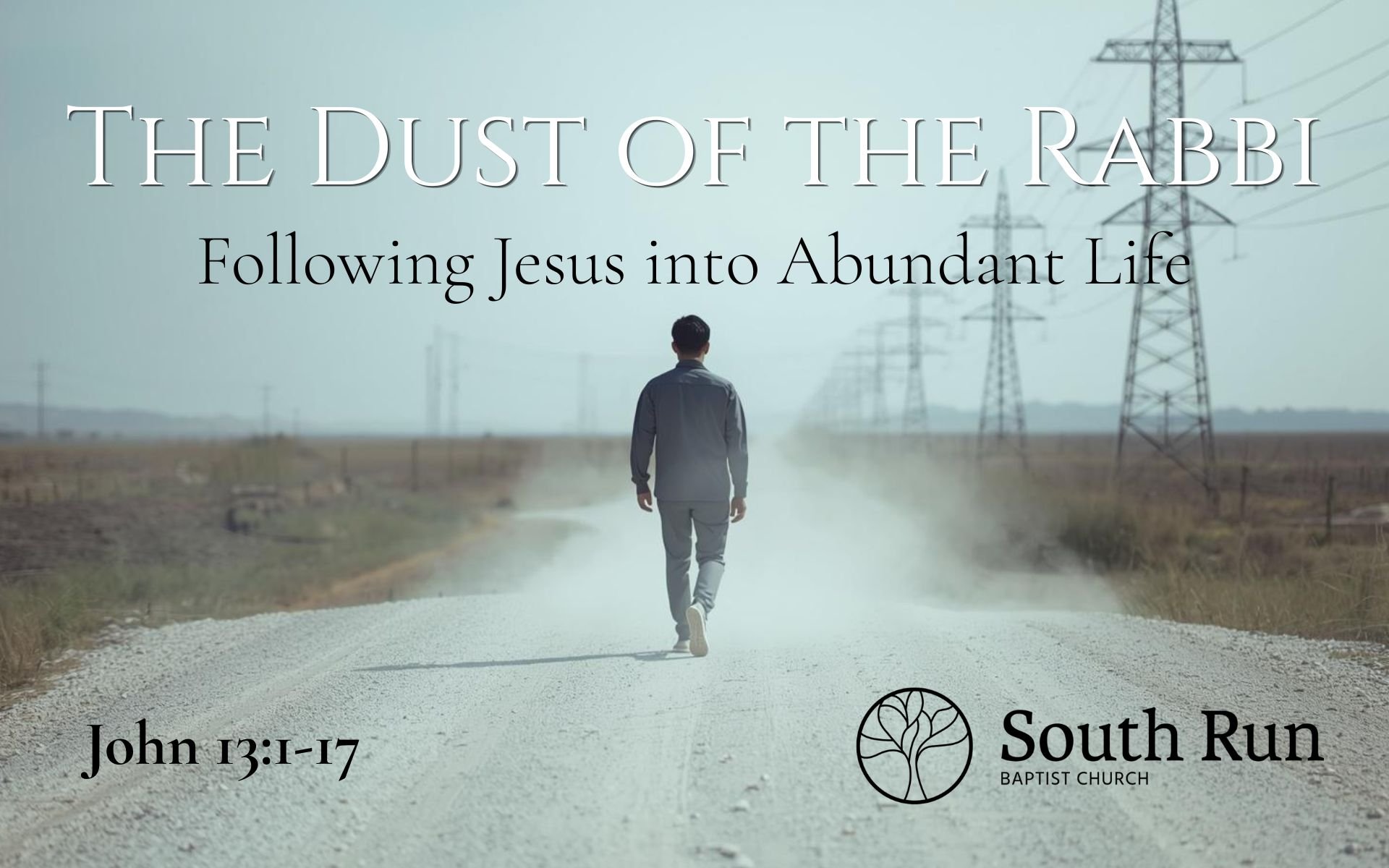
What if the secret to a fulfilling life is the exact opposite of what you’ve been told? In this message, Pastor Eric walks through one of Jesus’ most surprising moments — getting on his knees to wash his disciples’ feet — and what it reveals about how to actually live a good life.
This Sunday we're exploring:
The surprising paradox at the heart of the Jesus way: the secret to finding fulfillment, purpose, and abundant life is to stop looking for it and start looking for someone who needs it
An ancient Jewish blessing, "May you be covered in the dust of your rabbi," and what it means to follow Jesus so closely that his life becomes yours
John 13 and the night Jesus picked up a towel and washed his disciples' feet, including the feet of Judas
Why the Bible — from Genesis to Revelation — returns to the same theme over and over again: a life bent toward serving others is the only life worth living
Check out the weekly sermon here or on our SRBC podcast on Apple Podcast or Spotify.
-
The Dust of the Rabbi: Servant Leadership and the Foot Washing of John 13 — Sermon Transcript
South Run Baptist Church | Springfield, VA
Pastor Eric Gilchrest
John 13:1–17
This is a full sermon transcript from South Run Baptist Church in Springfield, Virginia. In this message, Pastor Eric Gilchrest preaches on the foot washing of John 13 and the call to servant leadership. This sermon is part of the ongoing "The Jesus Way" transformation series and addresses what it means to follow Jesus so closely that his dust gets on you, how servant leadership is the gravel of the narrow road, and why a life bent toward others is the path to abundant life.
Good morning. It is really good to be with you this morning. We are today talking about — well, I had one of those moments this week where everything seemed to align, and the stars came together. Have you had one of these moments? And it was like everything felt right. It was the title to the sermon. I just kind of had one of these moments on, I think it was on Tuesday, where I knew the direction I wanted to go, and then I was driving to get my daughter from school, and it was like, oh yeah, the dust of the rabbi.
It's this phrase that comes to us from the Mishnah, actually, which is kind of the extension of the Hebrew texts, and the Jewish folks would read out of this. And the idea is quite simple, actually. It's a blessing that they would pray over one another. And it says, may you be covered in the dust of your rabbi. The idea being, you should be following your teacher so closely that whatever dust he's kicking up, that it's getting onto you, and you are being transformed by that person.
Now for us, our rabbi is Jesus. And the hope is that over the coming months, and as we continue on in this series on transformation, that we learn to walk so closely to the person of Jesus that his dust gets all over us, right? But why this worked for me and why I was just so excited is because it worked on a few levels. Because today we're talking about Jesus and the foot washing and the need to wipe off some of that old dust, right? And the dust that maybe the disciples had been in some of the wrong places — and Jesus is coming along and purifying them, cleaning them from that, and then showing them a better way.
The Jesus Way Series: Alternating Between the Narrow Road and the Seven Deadly Sins
We're talking ever since Easter about these two ways. Jesus tells us that there is a way that leads to life and there is a way that leads to death. And if we follow him, the rabbi, ever so closely on that way to life, I believe that abundant life is waiting for each and every one of us in this life, and eternal life is waiting for us on the other side. But Jesus makes it very clear that this road is a narrow road, and that it seems few choose this road. And that the few who do live truly alive in this life, well, he's going to lead them in that right direction. But for the many, there is this other road. There's a broad road. And the broad road, of course, leads to death or to half-lives or away from life, away from God.
So the way this is going to work over the foreseeable future here — I've actually mapped out some terrain for us to journey together, and we're going to be kind of alternating back and forth between the broad road and the narrow road and what it means to, and what it feels like to walk on that way that leads to life, the way that Jesus is showing us, and we're going to read Jesus' teachings and look at the sort of model he models for us. And then we're going to talk about the broad road and what that road looks like and feels like. And to do that, I am going to dust off my own expertise in the seven deadly sins. I have a lot of personal anecdotes from my life that I plan to share with you about envy and sloth and gluttony and the like. No, I actually won't do that much, but we are going to talk about the seven deadly sins and how they can entrap us and how easy it is to actually fall into that road unwittingly and to find ourselves in some of those places.
The premise of the whole next leg of this transformation journey that we're on together is really quite simple. It's so simple, it almost feels too simple. But it goes like this: Jesus wants to teach us how to live a life. He lived a life. He taught us many things. And now he wants to teach us how it is to live that life. And I think that that life that he's trying to teach us to live is indeed an abundant one, and a good one, and a fulfilled one, and all the things we all want in life. And it's sitting there waiting for us if we just follow the rabbi close enough and get a little bit of his dust on us.
Let's start with prayer. Heavenly Father, I thank you for those who have gathered here, and I ask a prayer of blessing on them. May they be covered in the dust of the Rabbi Jesus, who teaches us what it means to live abundant lives. We pray this in your holy name, Jesus. Amen.
Steve Jobs' Last Words and Jesus' Last Night with His Disciples
This week, I was listening to a podcast. I do this a lot. And the person who was doing the speaking offered up a tale of the end of Steve Jobs' life in which she said the very last words he spoke — she thinks like he had set this up, there was like maybe a camera crew — but his very last words were, "Oh my," and then he died. Oh my. And it was one of these like, oh, well, what did Steve Jobs see in the last moment? And so the woman who was doing the talking then asked the others who were part of this, what would you want to say as your last words?
And it got me thinking about this sermon, which is in some ways about Jesus' last words to his disciples. Now, it's not him on the cross, but it's like one of his last nights with them. Now, some of the Bible folks in here who have been in the church for a very long time may not know a really important fact that I'm about to tell all of you, and it goes like this.
What John's Gospel Has Instead of the Last Supper: The Towel and the Basin
Last week, we took a pretty hard look at the importance of communion. And on the night before Jesus was betrayed — right, this is, you know where this is going — like, we take communion, and then he has this meal, and when we take communion, we quote from either Luke or Matthew, and we talk about the Lord's Supper. And we talk about two symbols, the bread and the cup, right? Well, here's what some of you Bible people may not know. That only appears in Matthew and Mark and Luke. John actually does not have a Last Supper scene. Instead, he has what we read today. He has a foot-washing ceremony.
Now, I've been told if I were to bring a foot-washing ceremony into this church, no one would attend because it's gross and kind of awkward and a little too intimate. And yet this is what Jesus says, and he even says in it, like, go and do likewise, right? I mean, so he says this with the table, right? "This do in remembrance of me," right? And so he's telling the disciples, go do this. Well, John 13 is the same thing. He says, like, go and do this. But somewhere along the way, the church has got a little uncomfortable with this one, and so we don't.
I think these two things, communion and the foot washing, there's a really big Venn diagram where they overlap a lot. And he's saying something very similar in both. And the similar thing is that we are to be people who serve one another to the point of being willing to lay down our lives. This is what love means. And this is what it means to love one another. And this is what it means to follow Jesus.
John 13: Jesus Washes the Feet of Peter and Judas
John describes an intimate scene with his disciples just before his death and resurrection. But rather than the bread and the cup, we instead have the symbols of a towel and a basin. And Jesus is washing the feet of the disciples. There's no doubt that the disciples and Jesus had been walking a dusty road together. And they were ready to kick back and enjoy a nice evening. But before they do, Jesus says, let's clean up. And he puts the towel around his waist. And he says, I am going to wash your feet.
John, to just quote him here, says, "Jesus laid aside his outer garment and taking a towel, tied it around his waist and poured water into a basin and began to wash the disciples' feet and to wipe them with the towel that was wrapped around him."
And there's a feature to this scene that might go unnoticed, but since I preached on it very recently, you might be able to draw this back to your memory. Do you remember the woman who came into the Pharisee's house while Jesus was in there, and she's a prostitute? And she begins to wash his feet with her tears. Do you remember this? Right? And the Pharisee watches this happen and is scandalized by it and says, look, if you knew who she was, like, you wouldn't be allowing this. If you were a prophet, like you say, you would not be doing this. Of course, Jesus is there and he is relishing the opportunity to cleanse this woman's soul. And he says to her, your sins are forgiven.
Well, in John 13, I think Jesus is doing much the same thing. If we were to use the image of the sermon title as the starting point, we might say Jesus is cleansing the disciples of the dust that has gathered on their feet from following the broad path that leads to destruction. He is wiping them clean and showing them the path that leads to life.
But it's a good thing the Pharisees aren't there that evening because the foot washing scene is doubly scandalous. It is not a sinner that is washing Jesus' feet this time. It is Jesus playing the role of a servant, stooping down, grabbing the dirty, smelly, road-worn feet of the sinners in that room, and starting with Peter, who Jesus knows will deny him. And worse yet, Jesus touches the sinful feet of Judas, who Jesus knows will betray him. And if the Pharisees had seen this, what would they say? If he were a prophet, how could he possibly touch the feet of such sinners? But this, of course, is the whole point. Jesus is there for the sinners, like you and me, to wash them clean of the dust of the broad road, and to touch them, and to bring them back to the road that leads to life, even if one of those sinners is going to stab him in the back.
John 13:12–17: The Explicit Command to Wash One Another's Feet
If you look ahead to verse 12 in this passage, Jesus goes on. He says, "Do you understand what I have done for you? You call me teacher" — you call me rabbi, is what it is — "and lord, and you're right, I am. If I then, your teacher and your lord, have washed your feet, you also ought to wash one another's feet." And then he says, ever so explicitly, "I have given you an example that you should do just as I have done to you." You should do just like I've done to you.
"Truly, truly, I say, a servant is not greater than the master, nor is a messenger greater than the one who sent him," by which he simply means Jesus is greater than us, and if he's doing it, well then we better be doing it as well.
Servant Leadership: Invented in 1970, Modeled by Jesus of Nazareth 2,000 Years Earlier
The phrase servant leadership that we're all probably familiar with by this point was invented in 1970, which is not long ago in the span of history. But the idea of servant leadership — it was given to us by Jesus of Nazareth. It is a critical part of the narrow way. When Jesus picked up the towel and the basin that evening, and he washed the disciples' feet, and he said, I am your example, he was showing us everything I'm trying to say, which is how to live a life. He's showing us how to live a life when he does that for his disciples. And if he were in the room right now, he would look at you in the eyes, and he would say, I am your leader, and this is what I do for those who follow me. Now go and do likewise.
The paradoxical wisdom of Jesus is, of course, on display here for all to see. Is Jesus the servant? Is Jesus the leader? Yes and yes. He is both. He is master. He is servant. He is lord and slave. He is the servant leader, and he shows us that this is the narrow way. It's the paradox that shows up when Jesus says to those who wish to hold tightly to their lives, well, they will lose it. But those who die to themselves and live the Jesus way, well, they will find life.
Jesus' Entire Life Was a Life of Service: From the Lepers to the Wedding at Cana
When Jesus washes the disciples' feet in the upper room, you can rest assured that this was not a one-off sermon. This wasn't the only time he talked about this. In fact, if you pan out on his life, you'll see he's doing this and he's teaching it and he is modeling it throughout his entire life. Every step of the way. It was always about others. The lepers, the sinful woman, Zacchaeus, the blind, the father of the daughter who died, the woman who had been bleeding for years. There are so many examples. It's really unnecessary to name them all. His whole life was spent in service to others.
Even the one scene in John 2 where he's at a party and the wine runs out. And he says, look mom, my time hasn't come yet. But instead he does what? He serves the party by turning water into wine. He is a man who is on the lookout for the needs of others, and then he serves them.
Jesus Was the Most Fully Alive Person Who Ever Lived — Not Somber, Not Bore-Ville
If you were to ask me, who is the most joyful and alive person to ever live on this planet? I wouldn't hesitate to say Jesus. Jesus was. He had to be, right? In fact, if your picture of Jesus is somber and downcast, repressed or depressed, unfun, or what my mom would call bore-ville, then you've got the wrong guy. You've been worshiping the wrong Savior all along. Remember, this is the guy that the sinners loved. This is the guy who brings the wine to the party. This is the one who John tells us in the prologue of his gospel, he says, "In him was life. And this life is the light of man." Jesus, in the most literal way I can say this, is the life of the party.
And here's the important part. He is trying to teach us how we too can be the life of the party. How we can be fully alive and bring life to others. How we can find happiness and fulfillment and meaning and all these other things that everybody seems to want. And the answer starts with, again, a paradox. Stop trying to serve yourself and start trying to serve other people. Because in doing so, you'll find the life you were always meant to live. Or as Jesus says it, if anyone would follow me and be covered by my dust, let him deny himself. Because in trying to save your life, you're going to lose it. But by losing your life and giving it over and giving it away to me and to all those around you, you will find life.
The Gravel Under Your Feet: Is Your Life Others-Centered or Self-Centered?
Living a life of service is the very path to the abundant life. It is the gravel upon which we walk when we walk this path. It is there every step of the way. It's not a fork in the road. It's not a waypoint that you get past and move beyond at some point. It is an ever-present part of the path. To be covered by the dust of the rabbi is to walk the path that he walks. And the gravel under his feet is a gravel that is others-centered. It is a life of service, looking out for those in need and meeting those needs to the best of your ability.
And so if you're walking a path, the path that is your life, whether this is today or like 25 years from now, and you happen to take a moment and you look down and you're looking at the gravel that's under your feet, I would encourage you to stop and take notice. Is your life and the way you're walking and the path you're on — well, is it primarily others-centered and God-centered? Or is it self-centered? What does the gravel under your feet look like right now as you think about the life you're in?
Are you seeking to gain the world but will forfeit your soul? If so, there is only one thing you should do right now, which is to stop. Stop everything you're doing. Get on your knees. Repent and find the quickest way back to that narrow path. Because rest assured, you're on the broad way that only leads to death and destruction. But if you stop and you look beneath your feet, and the gravel that is there tells you that your path is God-centered and others-centered, and the dust that has gathered on you looks a whole lot like the kind of dust that Jesus wore, then my friend, congratulations. You are on the path of righteousness and to life. And keep going. Even when the terrain gets tough and rough, keep going.
Application: Get Your Towel and Basin Ready — Someone Needs You
An application to a message like this is quite simple. And so I will keep it very brief. It begins with a towel and a basin. I shouldn't need to say it. But in case you need me saying it to you, here's what you are to do.
After I finish this sermon, I will pray, and then we will sing a song together, the final song, and then you are going to stand up and start heading for that door. But before each of you hits that door, you will see a room filled with people who have deep needs in their life. And it is quite possible that you are the person who can meet one or two of those needs. You don't need to meet them all. You can't. And not even Jesus would try to do such a thing. But you can meet one of those needs.
But then you'll walk out that back door, out of the church building, and onto a mission field where you'll bump into lots of people, maybe while shopping at Giant or walking through your neighborhood. Or if you hit up the slug lot on Monday mornings, you'll be in a car with some people. Or you'll sit next to people at school. Or there's any number of ways you will run into hundreds, if not thousands, of people in this area. Every last one of them has a deep need. Many of them are on a wide path that leads to death and destruction. And they need to be brought back to life. You happen to know a man who brings people to life. Abundant life in this life. Eternal life in the next.
The Jesus way, the narrow way, the one that has the right gravel under your feet, is one in which you are looking out for the needs of others and taking the God-given abilities and the passions that are sitting within you. You're serving others in the same way that Jesus served his disciples. The life well lived is a life bent toward other people. Serving others, showing up for others, turning outward when everything in your DNA and everything in our culture is telling you to turn inward.
It is going to take time, but if you let Jesus do this kind of work in you for a while, you'll begin to know you're on the right path when service itself stops feeling like a detour and it stops feeling like a burden and it starts feeling natural, life-giving, and it becomes part of who you are. So today, get your towel and basin ready. Someone needs you to wash their feet.
Let's pray together. Father, Son, and Holy Spirit, we sang a song earlier that said that you were working in this place. I know that to be true. You are always working. Sometimes we don't feel it, like the song said. Sometimes we do. And sometimes we know exactly what you are calling us into. We know exactly where you are putting your finger in our heart. And you are saying, I want this from you. I need this part of you. I want you to do this thing. And God, I have no doubt this morning that you are doing that with people in this room. People who are listening to this message. And you are saying to them, you are calling to them: I have a bigger vision for you. I am calling you into an abundant life. And I want to use you as my servant in this world to bring people back to life. And so God, I ask, may we be people who are not only open to your message, we aren't resisting it, but we are following. That we follow you, Jesus, the master, the rabbi, ever so closely, that your dust is getting all over us. We pray this in Christ's name. Amen. Amen.
South Run Baptist Church | 8712 Selger Drive, Springfield, VA 22153 | Sunday Worship at 11am
Serving Springfield, Burke, West Springfield, Lorton, Alexandria, Fort Belvoir, and Franconia, Virginia.
Listen on Apple Podcasts or Spotify