
-
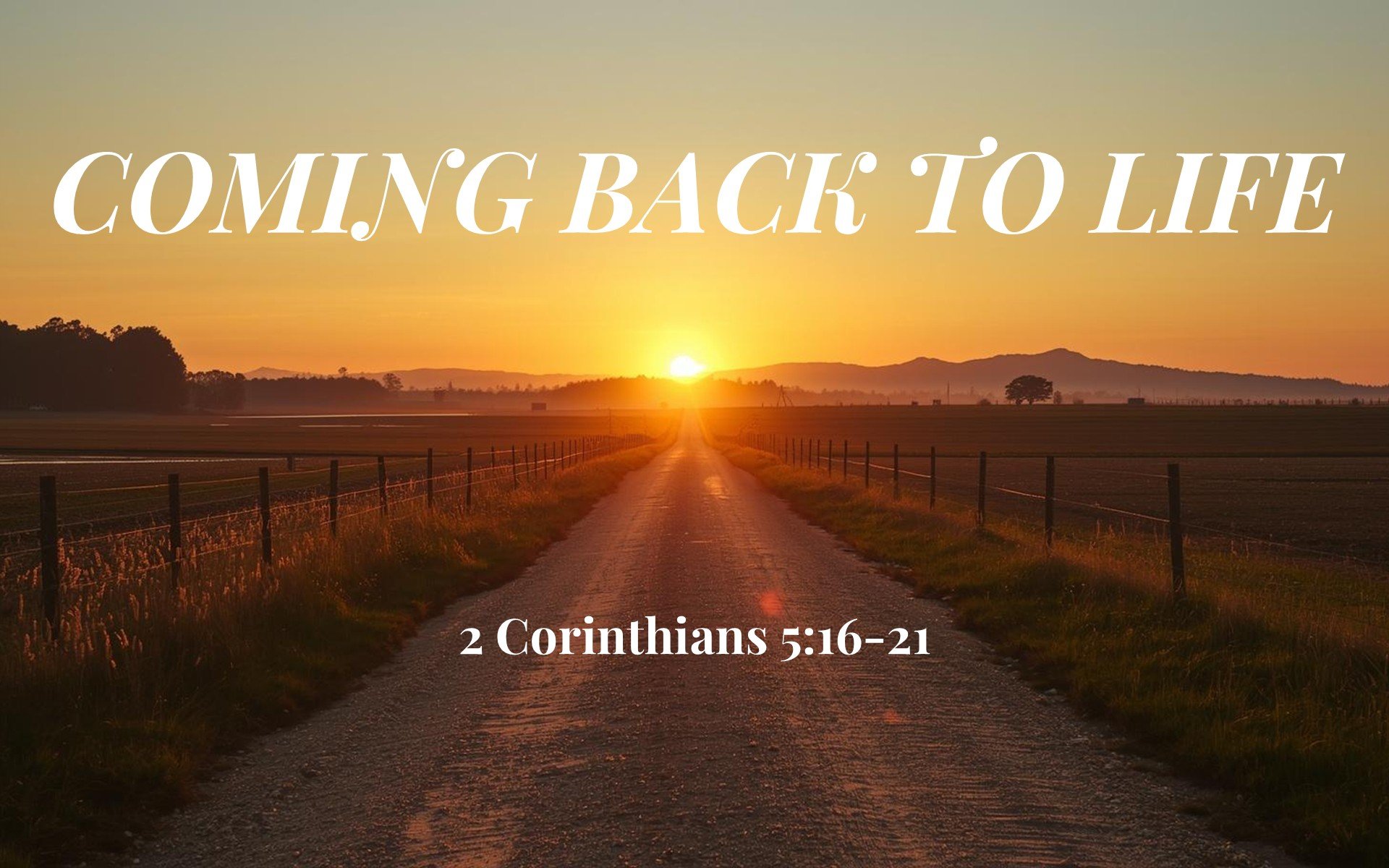
Coming Back to Life
South Run Baptist Church | Springfield, VA
Pastor Eric Gilchrest
2 Corinthians 5:17–20
Easter Sunday
This is a full sermon transcript from South Run Baptist Church in Springfield, Virginia. In this message, Pastor Eric Gilchrest preaches on new creation and the ministry of reconciliation from 2 Corinthians 5:17–20. This sermon was delivered on Easter Sunday and addresses what it truly means to be a new creation in Christ, the two mental models of transformation — instantaneous and lifelong — and the mission God gives every believer to be an ambassador of reconciliation in the world.
Opening: G.K. Chesterton, the Poet-Priest, and the Reminder That You Are Not Dead Yet
What a morning. Can I get an amen? Amen. Ah. There's a writer from the early 1900s that I quite like, and I quote from time to time. And there's a book he wrote called Man Alive. It's one of his lesser-known works. The guy is G.K. Chesterton, and in it he says this:
"I don't deny that there should be priests or pastors to remind men that they will one day die. I only say that in certain strange epics — or maybe certain strange days — it is necessary to have another kind of priest, a poet, actually remind us that they are not dead yet."
I come to you this morning not as a pastor, but as a poet, reminding you that you are not dead yet, and that you too can come back to life.
Let's begin with prayer. Heavenly Father, I come, we come into this sanctuary, and we want your presence. We feel your presence. We want your spirit. We want the spirit of life that hovered over the waters in the ancient deeps at the creation of this world when all things had not yet been made but were made through you, the giver of all life. Lord, that spirit is the one we are seeking right now. It is the spirit that rose Jesus from the dead, and it is the one that has been promised to us to dwell in our hearts and to bring us back to life as well. God, give us your spirit. In Christ's name we pray, amen.
The Two Roads: The Narrow Path to Life and the Broad Road to Death
The scriptures talk about two roads with great frequency — a road that leads to death and one that leads to life. Jesus talks about it as the broad road and the narrow road, and he reminds us that many go on the broad road and quite a few, for some reason, choose the narrow road. I take these two roads to be much more important than they are often made of, because I think if we can grasp these two roads and that they are on offer before us at every single moment, we actually can grasp quite a lot about some of life's biggest questions. Life's questions like: Who is God? Who am I? And perhaps most importantly today, how do I live a good life?
Who is God? Well, he's the author of all living things. The one who creates the world, all that is alive, and he says all is good. And so where you have experienced life and goodness in this world, in this life, you have experienced God. And who am I? Well, you are a child of God. You are created in God's image to bear his image, the image of the life-giving one. And well then, what do we do? And how do I live the good life? Well, by choosing the path that leads to life, by choosing the Jesus way.
The question still remains a conundrum. Why would so many choose the narrow path — the one that leads toward death? Why not choose life? And I don't believe it's because they love evil, though some do, but it's because the broad road is the easy road. It is the frictionless path. It is the path of least resistance. It requires nothing of you but to simply coast. The narrow road, well, it requires discipline and adeptness. It looks more treacherous than the broad road does. The narrow road has fewer people on it, naturally, and so it causes you to wonder, is this actually the way at all? Why do I feel so alone out here? The broad road has company, and there are many joining with you. It feels safe. There's safety in numbers, after all, right?
The narrow road leads to life, the broad to death. The narrow leads to God, and the broad road, well, it leads to separation from God. The narrow is rightly called righteous — or if you need a less churchy term, just simply good living. Living in accordance with the grain of God's image within you. And the broad road, we call that sin. Or again, if you want something less churchy, wrong living. A way of being that is ultimately self-destructive. It is settling for a lesser life, something that might be good, but not great. But too often, it's not even good. It's not a good life at all. We often choose paths of hurt or hate, addiction or division.
What It Looks Like to Be Fully Alive: The Blue Flame vs. the Red Flame
And so it is that living a life that is filled with life is indeed the narrow way. It's harder than we might think. And you know this to be true, even as I say it now, because how many of you and me, we live a life that is truly and fully alive? How many of you would look at your neighbor as they walk to get their mail and say, well, Jane, now Jane, she is fully alive. She is living her best life.
I encourage you right now to think of someone who is actually this kind of life liver. To help you, you should probably consider the fire analogy. You're not necessarily thinking of the person who burns the brightest. You're trying to think of the person who burns hottest and most consistent. We're thinking of the blue flames, not the red flames. It's easy to throw a few pieces of kindling onto a fire and make it flare up, but it's a whole other thing to build a big burning bonfire that burns long and large with thick pieces of wood, making it near impossible to extinguish. These are the people I want you to think about. How rare is this person in your experience? The one with a bonfire in their heart that burns bright and clear and strong.
Romans 12:2 and the Year-Long Theme of Transformation at South Run Baptist Church
If you're visiting today or just started attending our church, then you might not know that since January we've had one theme going on here. We've got a verse, Romans 12:2 — "Be transformed by the renewing of your minds." We've got bracelets to boot, and they're in the back if you'd like one on the way out. We've been teaching about it. We've had a marriage workshop on this, and I've been doing everything I can to get you to think about one thing: transformation. And so if you're new here, and you're looking around the room, and you're thinking, boy, these folks are supposed to be transformed — I'd encourage you not to judge too hastily, because you should have seen them three months ago.
2 Corinthians 5:17: If Anyone Is in Christ, He Is a New Creation
In 2 Corinthians 5:17, our scripture for the day, Paul says that if you are in Christ, we are a new creation. And then he says, "The old is gone, the new has come." And this has everything to do with Easter, when the new creation has begun with the resurrection of Jesus, and death is defeated, and Jesus comes back to life, and he opens the door to the rest of us to follow him in this new creation living.
What new creation means for me and for you is nothing short of miraculous, and yet it is filled with misunderstanding. I think there are two mental models for what is happening in new creation and transformation, both of which are true, but you've got to carry both of them together at the same time.
Mental Model One: The Instantaneous New Creation — Baptism and the Miracle of the Moment
The first is that the new creation, the new that has come into your life, is instantaneous. When your head goes below the waterline of the baptismal pool and the pastor proclaims, you are baptized in the name of the Father and the Son and the Holy Spirit — you are instantaneously changed from old creation to new creation. It's a miracle. I want to affirm this and say that there is something deeply true about this. A miracle has happened. It's a mystery, and it is immediate and it is unexplainable what happens when you call Lord Jesus, Lord and Savior of your life.
But my son Asher was baptized today, and I am so proud of him, and he is indeed a new creation. But should I expect this new creation will never talk back to me again, and that he will always choose to listen to every word I say and obey with perfect humility and grace and honor his father and his mother, will he never again need forgiveness because he is this new creation? I suppose that is yet unwritten, but I'm not counting on it. Which gets me to the second mental model.
Mental Model Two: The Lifelong New Creation — Growing Up Into the Image of God Over Time
One of growth and maturity. This last week, my wife sat down for many hours — and she would want me to emphasize many, many hours — pulling together photos of our eldest son, Ezra, as we prepare for Senior Sunday, when we all get the joy of watching our kids grow from infancy into the age of 18. The maturing happens over this 18 years, and it is nothing short of miraculous. There is a true change in body and mind and even spirit. Ezra too was baptized about the same age as Asher, around age 9 or 10. And the 18-year-old Ezra standing here today — well, you would be a fool if you thought he was the same person as the 10-year-old version of Ezra. He is not. He is indeed a new creation. He's just eight years older, though, of this new creation. They are the same person. They're just eight years apart. A new creation of the old creation.
There is a mental model I'm offering you of growth and maturity that happens over time that is also part of the new creation that we are all called into. This is, in fact, the model I've leaned into all year to this point. It turns out the bonfire of your heart is not built in an instant. It is built over a lifetime. Coming fully alive is not something that happens in the twinkling of an eye, though it starts there. It does happen with deliberate practice and intentionality. Moving from the old to the new is the project of a lifetime, and if you're not careful, there are detours and broad roads that can sweep you up for long stretches of life's journey.
Staying on that narrow road is in fact tough, but getting back on the narrow road takes a mere instant — a decision, a decision point that some of you might need to make today. The choice is always in front of you, and there you have it. The two mental models of becoming the transformed you, the new creation you. One is immediate and in the twinkling of an eye, a choice, a prayer to which God always answers yes and amen. Welcome home, my prodigal son, my prodigal daughter. And the other model, it takes all the time in the world to transform. And it must be managed and maintained. It is a road that is walked.
The road to life can be chosen today, but it must be chosen again tomorrow, and the next day, and the next. And the journey is never done until it is done. And so it must be carefully guarded and walked intentionally with discipline and with care. You can think of the road of life just as the road the prodigal son walked in returning to the Father. The road was leading back to life, back to the Father, and back home. It is where our lives are indeed heading right now for those of us who remain on the road of life. We will one day find ourselves welcomed home by the Father.
Reconciliation in 2 Corinthians 5: God Brings Us Home Through Christ
Paul is more or less saying this same thing in our passage today. He says that in this new creation, God reconciled us to himself through Christ. He reconciled us to himself through Christ, which is kind of a mouthful, but it simply means this: God wants us to come home to him. He loves us, and he wants to be with us, and Christ walks the way home for us, and he takes us with him. He shows us the way that leads to life for all who walk with him. To be reconciled, then, is simply to be in God's presence, to the source of all life, the one who in the beginning spoke life into being. New creation then is a homecoming, a coming back to life.
It is interesting to me, and I think it should be to you, that when Paul talks about new creation — and he does so in a few places in his letters — every time he does, he reminds us that we are made in the image of God. This is the language he uses. And he's of course pulling that from Genesis 1. And so in Colossians 3, for example, he'll say that we are to put on the new self, which is being renewed after the image of its creator. We're being renewed into this image. Or again, Ephesians 4, put on the new self created after the likeness of God.
The goal of the new self is becoming a lot like the oldest self that you actually have — the self that got buried way down deep and crusted over with sin and the hardship of life. The brokenness of a half-lived life. But Christ wants to bring you back to the source of life and reunite you with God, the author of life. And he shows us this way home.
The Mission of Reconciliation: You Are an Ambassador for Christ — 2 Corinthians 5:18–20
But there is one more really important piece of what Paul is saying this morning to every last one of you. Perhaps you've been persuaded that the path to God is indeed the path to life. And you have entered this path, both in the immediate sense, in the decision you're making in this moment, and a lifelong maturing over time. And you're gearing up for a life of abundant life and looking forward to eternal life, just like the four who were baptized this morning. But there's more.
Because God is not so self-centered as you and me. You see, this is not really about us. It's actually about the world. And God so loving the world. The second half of verse 14 in our passage today says that not only has Christ brought us back to God, but he has then dropped a mission on us. We've got things to do. A ministry. A purpose. A task. Something that we are compelled to do if we are indeed those people who have access to life. It says, He gave us the ministry of reconciliation.
The ministry of reconciliation. If you'd rather, we'll just call it a mission of reconciliation. A mission of going out to the people who need to come home, who need life breathed back into them. And that is the mission. This is your job and it is my job — to bring people back to life. Paul's command here is to be reconcilers, to be the wayfarers walking behind Jesus and then bringing as many people on this same path with us back to the source of life.
He says it here not once, not twice, but three times in a row that this is your mission. "All of this is from God," verse 19. All of this is from God, who through Christ reconciled us to himself and — first time — gave us the ministry of reconciliation. But he starts again. That is, in Christ, God was reconciling the world to himself, not counting their trespasses against them, and — second time — entrusting to us and to you this ministry of reconciliation, bringing people home. And therefore — third time — we are ambassadors. We go out into the world as life givers alongside the one who gave his life for us and gives life to us. We are ambassadors for Christ. God making his appeal through — of all people — you and me. He makes his appeal through us. And so we implore you, on behalf of Christ, be reconciled. And I would then add, and be a reconciler.
The Good News and the Hard Truth: Bringing Life or Bringing Death Into the World
As with many things in the Bible, there's good news and bad news here. I'll start with the bad. If your life doesn't look like one that breathes life into the world around you, but instead brings judgment, division, hate, and the fruit of bitterness wherever you go, then you're not living as an ambassador to the God of the living. You may not even be on the path of life. You're just bringing more death into the world.
But the good news is this. It doesn't have to be this way. If Christ is in you, then you have access to the source of all life, the same life that brought Jesus back from the grave. And so if you are looking for a life purpose, well, look no further. If you are wandering about, trying to figure out what to do with your life, look no further. Be someone who brings people to the source of all life, who teaches them how to walk the narrow road of life, how to have discipline, how to love like God loves, how to live like Jesus lived, how to lay one's life down for the other, that all might experience the abundant life that God desires now and the eternal life that God has in store in the life to come.
Closing: The Poet's Reminder — You Are Not Dead Yet
To end with G.K. Chesterton: I don't deny that there should be priests and pastors to remind you that one day you will die. I only say that at certain strange days, it is necessary to remind you that you are not dead yet and that you too can come back to life.
Let us pray. Father, Son, and Holy Spirit, do a work in the hearts of these people. Lord, you look upon them with love and desire. You want them back home. You want them on that road to life. It is not necessarily the easiest road, but Lord it is a fulfilling road. It is the road that leads to life, and the decision before us is always before us — every minute, every second of every day. We can choose one path or the other path. And Lord, today, may we choose life. We pray this in Christ's holy name. Amen.
South Run Baptist Church | 8712 Selger Drive, Springfield, VA 22153 | Sunday Worship at 11am
Serving Springfield, Burke, West Springfield, Lorton, Alexandria, Fort Belvoir, and Franconia, Virginia.
Listen on Apple Podcasts or Spotify