
Check out the weekly sermon here or on our SRBC podcast on Apple Podcast and Spotify. While you’re at it, check us out on Facebook and Instagram too.
Like what you hear? We’d love to know.
At South Run, we read every message personally. Whether you have a question, want to share how God is moving in your life, or are thinking about visiting in person, this is the place to start. If you click the link below, Pastor Eric will personally reach out to you.
-
Transcript
Pastor Eric J. Gilchrest
Good morning. It's great to be back with you. I've missed you.
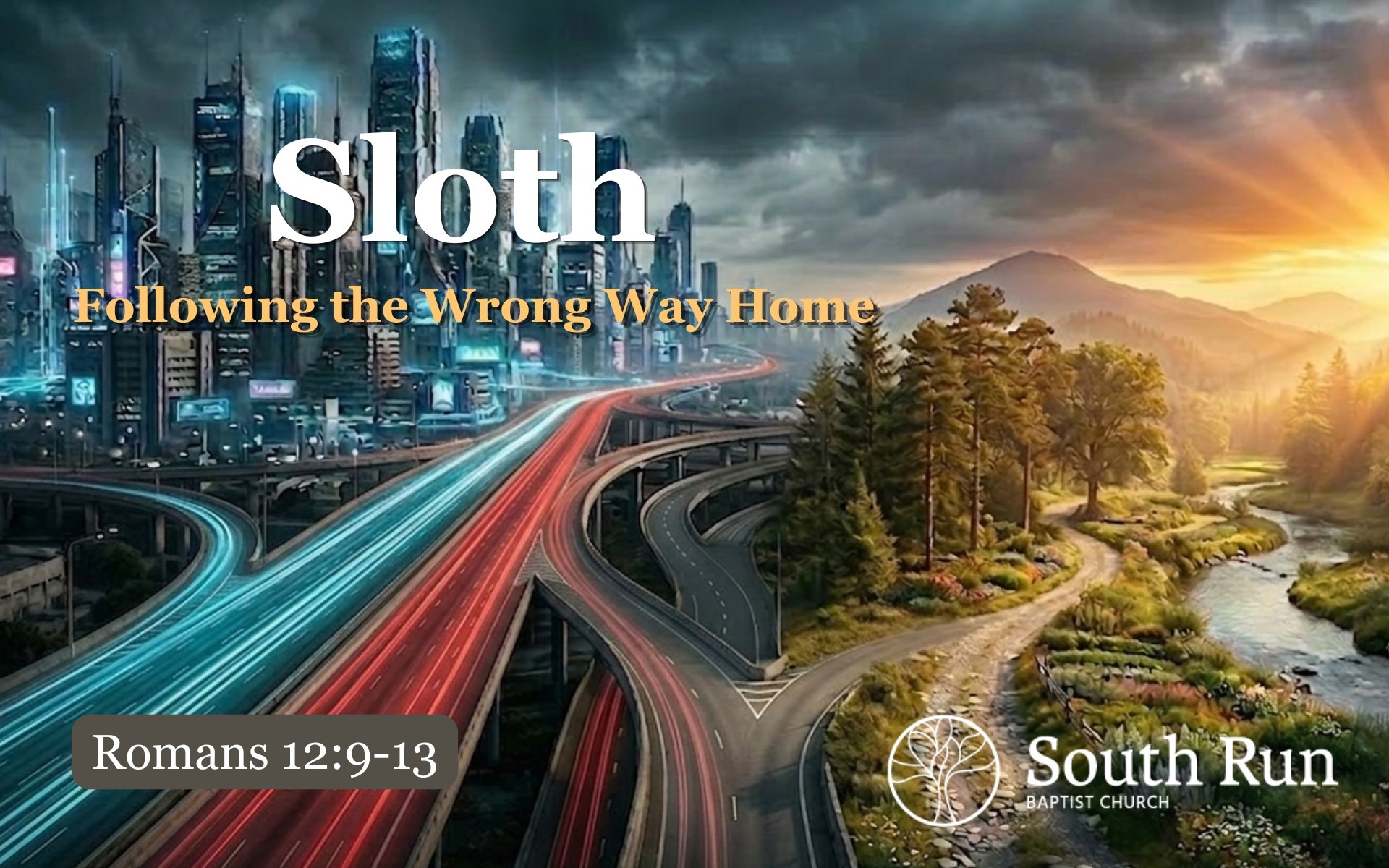
I wasn't here on Sunday, last Sunday that is. I was dropping Ezra off at college, which was an incredibly emotional, powerful experience. And then I had been out of town on sabbatical for a time, but I'm promising you I'm here for a while. Does anyone else hear that? It's the sound of... Oh, it is. Yeah. It's the 250th. There's like flyovers happening. I was going to say, I never hear, you know, anything quite like that. Yeah, we'll let the airplanes kind of die down a second. They'll be done in a moment, hopefully, unless it keeps going for a time. Yeah, just turn me up. Thank you. All right. Where were we? Where we were for the last month is we are talking about the way, which is the name for the earliest Christians. They were called the way. They were the ones who followed Jesus appropriately. And then we were also talking about the fact that there are these two ways that Jesus talks about. One way that leads to destruction. And this is the path that We've been talking about the seven deadly sins for. It is the path we're talking about today. It is the path in which we lead lesser lives, and we lead lives that are not intended to be led by God. Today we're talking about sloth, and this is, as it says, following the wrong way home. There's a lot of city stuff in the picture if you're looking at this, and there's a lot of hubbub and there's a lot of movement, and you might be thinking that's not very slothful. But actually, it kind of is. If you were in the Sunday morning Bible study, what we learned is that there are two faces to sloth, actually. The one that is the slow creature from Zootopia, who's amiable and enjoyable to be with, but is is so slow that it's infuriating, right? And they don't do much. But the other face of sloth actually is the person who's so busy and is distracting himself or herself with all these other things in life, and they're not attending to the one thing that they should be attending to. Our lives are actually filled with these sorts of slothful moments where we distract ourselves quite easily and we escape into our devices and we lead lives that are in constant distraction and not attending to the one thing that we should be doing. So Jesus talks about this road that leads to destruction. And this morning we're going to talk about sloth in that way. But he does talk about a road that leads to fullness of life, abundant life. And all year I've been trying to get you to realize there is abundant life waiting for each and every one of you. And this is in fact what God wants for you. Jesus wants this for you. It's the promise. It's frankly the great promise of Christianity. It's what Jesus teaches us, and he shows us the way. He walks the path before we ever do. And so when I got captivated earlier in this year by what I take to be a very simple idea, and the longer I sit with it, the more powerful it gets. And the idea is very simple, that Jesus lived a life showing us how to live a life. And if we just simply model ourselves after the life of Jesus, if we do the things Jesus does, if we speak like he speaks, if we walk like he walks, if we do what he does, then we too can have abundant life. So this morning, before we jump into sloth and we talk about what this means and what it doesn't mean, let us begin with prayer. Heavenly Father, We come this morning and we lift our hearts to you. We slow down in an appropriate way as you call us to every 7th day taking a Sabbath, a rest from the busy work of life, but not to be lazy, but to fall back in love with you, to be open to what you have to say to us and how you're directing our lives and where you're trying to move us to, the ways in which you are trying to grow us and the ways in which you have kingdom plans for each and every one of us. May we attend to you this morning. In Christ's name we pray, amen. I want to begin with an analogy from marriage. If you are not married, hopefully you can grasp what is happening here. This analogy takes place on the 2nd anniversary of a marriage when a couple is past the honeymoon phase and the 2nd anniversary happens and the husband forgets that it's the anniversary. And the wife is now deeply frustrated with her new husband and lashes out and says, how could you forget? James down the street, he took his wife to the Bahamas. You didn't even remember that it was our anniversary. You are a terrible husband. How dare you? And she storms off to the other side of the room. The husband, feeling very defensive and stonewalling, He just kind of turns in on himself and he walks to the other side of the room and he says, doesn't she know? I work so hard for this family, 80 hours a week. I am just, the pressure is so great. And so what? I forget one day, right? And he begins to get defensive. And so the couple is on each side of the room and And they both know that they love each other, right? This is why they married. They both know that they love each other. But the love requires sacrifice. And it requires the both of them to do the one thing that in this moment they're not sure they really want to do, which is to walk back to the center of the room and figure some things out. And to try to understand the other person and where they're coming from. And so what do they do? Hopefully they do what you don't do. They actually stay on the other sides of the room and they nurse their grievances and they choose sloth over love. And they choose to not reconcile. Instead, of choosing to die to self and to choose to try to work it out and love one another. If you've been married, then you know that building a relationship is not easy. What it really requires of this couple is to not exactly just figure it out in that moment. It actually requires figuring it out over a lifetime what the other person needs and what makes them happy and what makes them tick and what you need and where you need to stand up for your own self. And relationships require work and they require growth and they require you to talk about it and to do some hard things and to dig in together. Maybe on occasion going to a counselor or somebody who can help you grow together. And so a good relationship It doesn't just come together in that moment and all is well. It requires day in, day out, doing the hard thing. But if you don't want to do the hard thing, we call this sloth. Sloth is the willful rejection of growing into the person that God wants you to be. It is the willful rejection of growing into the person that God wants you to be. The marriage is just an analogy. It's an earthly analogy that should then be understood in terms of the spiritual realm, that God desires a relationship with you. And this God wants something from you, and he wants you to grow. And he wants you to be a bigger person, as we talked about again in Sunday school. He wants you to be magnanimous, which is to say big sold. But it's going to require work. And it's going to require some pain, maybe some late nights, some early mornings. Sometimes it requires eating some crow and saying, I'm sorry, and man, I really messed up. And coming to God and saying, please forgive me. It requires doing some soul searching. And it requires understanding what is it that God has called me into this life for? Why am I on this planet at all? And how can I serve the kingdom of God? Sloth is one of these sins that requires us to think about what sin is. Most of the time, someone might tell you, well, it means don't kill anybody. Check, not done that. Don't commit adultery, check, right? Don't steal, right? Okay, And you can think of all these things that you're not supposed to do. Sloth doesn't work this way. It requires actually the opposite. Sloth is what you don't do. It's the sin of not doing. It's the sin of not showing up when you should show up. It's the sin of knowing, I really should go do, I should really call this person, I should really go say I'm sorry to my wife and then not doing it. That, is the sin of sloth. The Book of Common Prayer has lots of prayers in it. one of which you might be familiar with. The prayer goes like this. Most merciful God, we confess that we have sinned against you in thought and word and deed by what we have done. And these are all the things that you've done. And it's a moment and opportunity of confession, right? To say, I've thought these things and I've said these things and I've done these things and God, I'm sorry for those. But the prayer continues and it says, by what we have done and by what we have left undone. And it's that. That's the sloth. That is what you're also saying. God, I am sorry that I didn't show up in this way. And then it goes on and says, we have not loved you with our whole heart. We have not loved our neighbors as ourselves. Often, the not loving others and not loving God with our whole hearts is just as much about what you leave undone as it does what you actually do. And the prayer ends, we are truly sorry and we humbly repent. This year is a year of transformation. If you've been here since January 1st, we gave out bracelets and it says transformed on them and we read from Romans 12, 2, and it says, be transformed, right, and take on the mind of Christ. And this whole year, my hope has been that you have been engaging in thoughts and words and deeds that are in fact transforming you. We even had a marriage conference where we came together and the hope is maybe we can transform some marriages. And we've talked about doing hard things. Sloth is enemy number one against transformation. It is week two of the transformation process where you say to yourself, you know what? I'm going to be the guy who wakes up at 5.30 in the morning and I go to the gym and I'm going to start each day with a good workout. And then by week two might be generous, right? A few days later, you're thinking to yourself, boy, It is early. I think I'm going to stay in bed this morning. That's the physical forms of sloth coming at you. But there are spiritual forms of this too. It is where you say to yourself, I'm going to be a guy who prays regularly. Or I'm going to be the guy or woman who comes to church every Sunday. That's who I want to be because that's important to me. prioritize this. I'm going to be the dad who shows up for his son's or daughter's stuff, right? And spiritual sloth can creep in and we shrink back from how it is that God is trying to form us and to shape us. In this year of transformation, we began with Romans 12, 2, and I would ask that right now you open your Bible to that chapter. Because interestingly, our passage for today comes from this very chapter, Romans chapter 12. As you're turning there, I'll go ahead and start reading from verse 1. The passage today is from verse 9, but we'll get there. Paul says, mind you, while you're turning there, Chapters 1 through 11 are what often get called orthodoxy. This is Paul teaching you how to think right. These are the things that matter and how we are to understand what Jesus did on the cross and what his resurrection means from a kind of cognitive viewpoint. 12 and after is orthopraxy. This is the life you are to live in light of all of those things from chapter 1 to 11. And so this is what Paul says here. I appeal to you therefore, brothers, by the mercies of God, to present your bodies, your very lives, as a living sacrifice, holy and acceptable to God, which is your spiritual worship. And then the passage for the year, do not be conformed to this. Be transformed by the renewing of your mind, that by testing you may discern what is the will of God, what is good and acceptable and perfect. Be transformed. These are lofty ideas, aren't they? And if you've been trying this for the last eight months, you realize lofty ideas turn out to be really hard when you're doing it for a while. And the process of real transformation takes some time. And it takes some energy. And sometimes it's just easier to forget about it and to give up. In fact, this whole living sacrifice thing from verse one, every day, a living sacrifice, you're telling me I've got to put myself back on that altar day after day after day? Eric, that's a lot to ask. I would say to you, it's not me who's asking for it. Paul is, but this is the life of faith. He goes on, and in verses 3 to 8, he calls us all together and he kind of reminds us of what it means to be the body of Christ together. And he says, we each play a part in this body and we each have things to do. And being a living sacrifice means playing my part in the body of Christ that is the church, both the capital C church and the lowercase C church, the church worldwide and the church local. And he says, for by grace given to me, I say to everyone among you, don't think of yourself more highly than you ought, but to think with sober judgment each according to the measure of faith that God has assigned. For as in one body we have many members, and the members do not have all the same function. So we, though many, are one body in Christ and individually members one of another. Having gifts that differ according to the grace given to us, let us use them. If prophecy in proportion to our faith, if service in our serving, the one who teaches in his teaching, the one who exhorts in his exhortation, the one who contributes in generosity, the one who leads with zeal, the one who does acts of mercy with cheerfulness. What does all that mean? I just say it like this. To be a living sacrifice means giving back to the body of Christ. If you're a deacon, be a good deacon. If you're a Sunday school teacher, be a good Sunday school teacher. If you're making meals on a Wednesday night, make great meals on a Wednesday night. But find some way to give, to be plugged in, to do something. Because that is part of what it means to be part of the kingdom and to do the things of the church. But he goes on, and this is our passage for the day. He says, let your love be genuine and hate or abhor what is evil. Love what is good, hate what is evil. It's really that simple. And hold fast to what is good. Love one another with brotherly affection. one another in the showing of honor. And then here it is, right? How I landed here at all. Do not be slothful in zeal, but be fervent in the spirit. Now let me just kind of back up one second. There's 2 ideas sitting here. Don't be slothful in your zeal, but be fervent in the spirit. The slothful in zeal, these are two words we don't really use ever, sloth and zeal, right? This means don't let your passion wane, but instead be fervent, another word we don't use a lot, but it really means boiling over. But be somebody who is alive in the spirit, and the spirit is boiling within them. And what Paul is calling us to in this in some ways is perhaps quite simple. He's saying that when you became a believer and you said yes to Jesus and maybe you walked down an aisle or at a camp you gave your life or you prayed, yes, Lord, yes, Lord, I will be your servant. There's probably some kind of fire burning within you in this moment. What he's saying is, don't let this fire die. Don't let it die. Instead, let it boil up. Because it's the boiling of the passion that then is very useful to the world that is around you. But if the passion that is in your heart, and all of these deadly sins, by the way, are heart issues, they're malfunctions of the heart. And if that heart is, it's lost its passion, then I don't know what's going to happen next. There is this ancient word that gets used for sloth. It's a nice fancy word. You can use it with your friends to impress them. It's called acedia, A-C-E-D-I-A, acedia. And it means, well, the word a means not, and cedia means care. It means you don't care. It means your heart isn't in it. means you've lost passion for the thing. If I could take you back for a minute to the couple standing on the other sides of the room. There's a real danger that might creep in if that couple doesn't figure out a way to get back to the center of the room. The real danger is that in year 20, when they are celebrating the 20th anniversary, and they no longer really celebrate much of anything, and they kind of, maybe they even sleep in separate rooms, and they've no longer come back to the middle. They have acedia. They no longer care. And the worst thing that could happen is that wife stops yelling at the husband to say, why didn't we celebrate our 20th anniversary? Because she no longer cares. And the husband no longer gets defensive and he no longer needs to protect himself because he too no longer cares. This is what sloth is. It's the stopping of caring. I coach soccer sometimes, although in the fall here I'm hanging up my coach's hat for a minute. I hope to again someday. But if you've ever worked with kids, you know what I'm about to say to be true, which is I can deal with kids, of course, the ones who care deeply and are really passionate about things. And then I can deal with kids who are passionately negative about something and they have some skin in the game and yet it's not working and they get upset about it, right? What I can't deal with is the kid who says, I don't care. That is a lack of love, if nothing else. If they say, Whatever. Okay, sure. Fine. Fine in my book is a four-letter word. It starts with the letter F. The reason being is it means that there is no passion. There is no love. There is only a cedia, a not caring. Sloth. is the willful rejection of growing into the person God wants you to be. For a lot of us, this happens because we stop caring. Sloth has a bodily form and it has a spiritual form. It's easy to see the spiritual form if we kind of first look at the bodily form. I mentioned last week we took Ezra down to Blacksburg and we dropped him off and it was a very emotional experience. I've never really had that kind of emotional experience before where I was deeply sad for myself and deeply happy for him because I know he's entering this window of life that is awesome. College is so much fun. There's so much growth that happens. And to be honest, there are days where I miss working with college students because of that window of time that is so cool. Yesterday, it hit me. Ezra wasn't there to mow the lawn for me. I had gotten out of the habit of mowing lawns It's been a few years, six years, my wife tells me. And I looked outside and my lawn was very full. And I thought, well, he's not here to do it. And Lizzie's, well, I don't know, I could try to train her. And Ezra's, Ashra's a little too young and looks like it's on me. I didn't want to do it. the sloth in me was saying, just stay inside, the air conditioning is comfortable. Maybe you could find another high school student out there somewhere and start paying that student. But I tried to, I overcame it and you'd be proud of me. I went out there and I mowed my lawn for the first time in six years. And it was fine. But sloth creeps in, a variety of ways. When we stop doing something over and over again and we offload it, right? And maybe it is like a physical thing, like mowing the lawn. But as I've already said, there are these other ways in which we become spiritually sloth. It's possible that like as parents, you were raising your kids in the house and And you knew, what, it's important that I teach this child like some things. And so I'm going to teach them how to pray. And I'm going to teach them to maybe read their scriptures. I'm going to teach them a few things about the life of the spirit. And then, they grow up and they leave the house. And well, now you don't have anyone to teach. And perhaps some of those muscles, for some of you older folks in the crowd, have begun to atrophy some. What I'd ask of you is to not let sloth jump in there. In fact, now's the time more than ever. There are people in this church who need you. They need your years of wisdom. They need what you've learned over a lifetime, and they need the food that you are able to feed them. Sloth can present itself in the body, but frankly, it's the spiritual sloth that is most dangerous. What should we do about sloth? With just very quick, I've got 5 steps I want you to take and then I'll pray and we can go home. But the five steps go like this. One, wake up. Wake up to the ways in which you've allowed a smaller life to creep into your life. in which God has called you into something bigger, but you've said no again and again. Or maybe it's like a sin that is sitting in your life right now, and you've just kind of grown accustomed to it, and you've allowed it to sit there, and at some point you say, I should probably work on this. I shouldn't let this just keep rotting inside of me. That is sloth on top of whatever that other sin might be. And so wake up, Number 2 would then be to rekindle that passion. So if Paul says in Romans 12, don't let sloth steal your zeal, but boil in the spirit, I'd encourage you to find that passion again. What was it that made you come alive? Or maybe it is in the workplace. what makes you come alive in life generally speaking? When I talk to young people and they ask, what should I do with my life? I often point them to, well, when you do something that makes you feel like invigorated, what is that thing? Because likely that is your gift to the world somewhere in there. And so what's that passion that is inside of you and how can you be using that for the kingdom? Number 3 would be to raise necessity. Raise necessity, which means somehow you've got to take this thing that God is trying to do in you and you've got to make it a necessary part of life where you are uncompromising about it, where you say, you know what, I'm going to do this no matter what. I'm going to drop all these other things and I'm going to do the one thing that actually matters. And then four would be to find accountability. Tell somebody, tell me, tell your friend, tell your mom, tell whoever and say, hold me accountable. This is my one thing. This is where God's growing me. I know it's going to be hard. I'm going to wake up at 5.30 one morning and not want to do it. And I need you to hold me accountable to it. And #5, just stay in the game. One foot in front of the other. In January, we started the year with transformation. My hope is some of you made some commitments. Some of you thought, you know what? I really do this year. I want to work on this. And over time, maybe you drifted. And this is the sermon that's ringing the bell to say, wake up and get back on track and do one thing, 1 foot in front of the other, in front of the other. Because sloth is coming for us And it's trying to steal our lives from us. And those screens that you keep looking at, they're taking your time and they're taking your attention. And that's part of what we need to put down in order to live the lives that God is calling us into. Let us pray. God our Father in heaven, we come this morning with confessions. Most merciful God, we confess that we have sinned against you in thought and word and deed by what we have done and by what we have left undone. We have not loved you with our whole heart. We have not loved our neighbors as ourselves. And so, Lord, we are truly sorry and we humbly repent. God, it is our desire this morning to live lives that are magnanimous that are big-souled, in which we are challenged by what you are calling us into. We are ready to take the next step of faith. And it's going to require some sacrifice. It's going to require being a living sacrifice if the transformation is going to happen. And so, Lord, I know my part. I'm saying yes this morning. And I know there are people in this congregation who are saying yes too. Let us find some accountability. Let us find some necessity. Let us fix our eyes on you, the perfecter of our faith. We thank you. In Christ's name we pray, amen.