
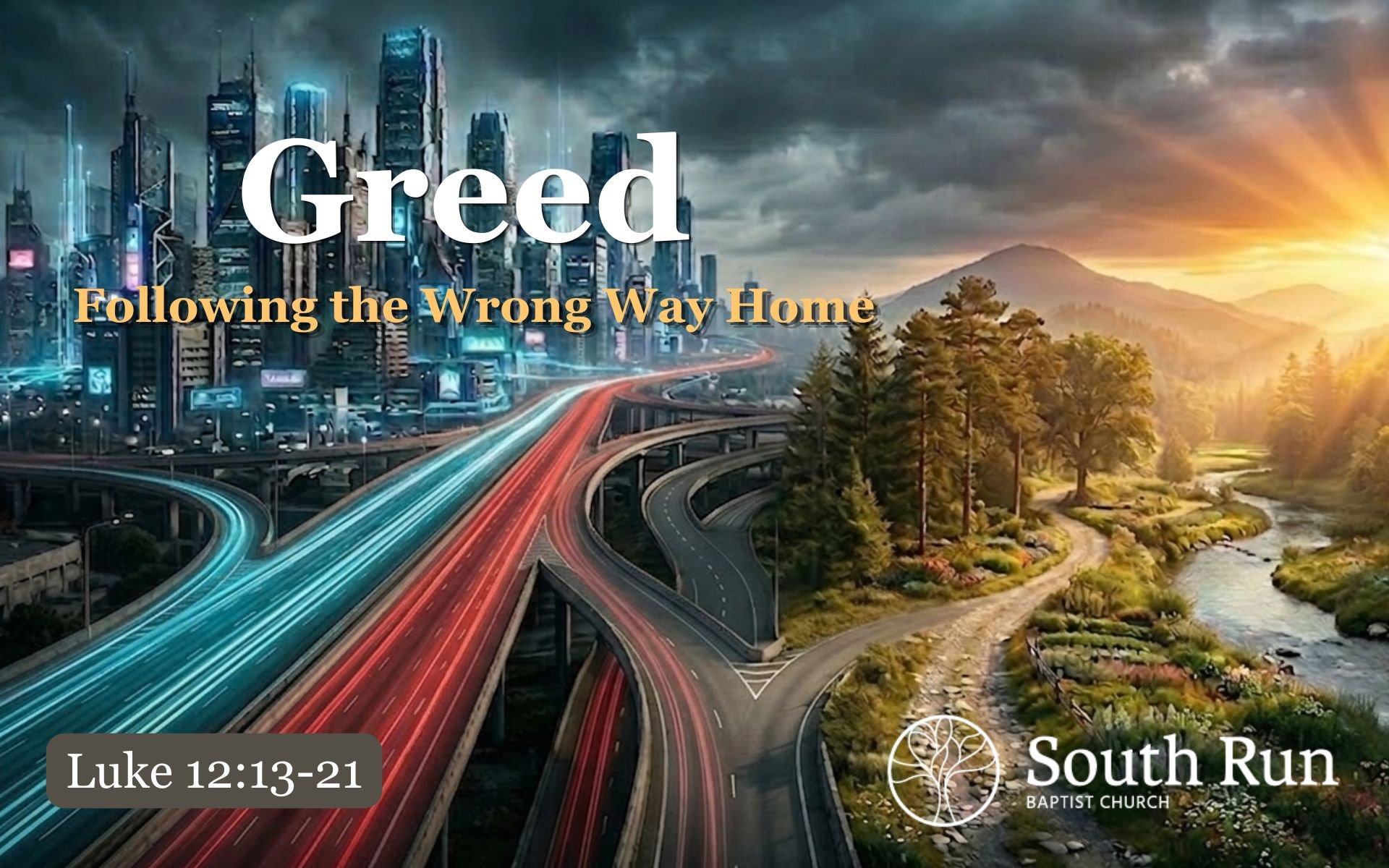
What is enough? How do you know when you have enough? Is the answer: “Just a little more . . .”? If so, you’re not alone, but you’re also on a dangerous road. From the rich fool who built bigger barns to the algorithm that lives in our pocket, something has always been working to convince us that the next thing is the thing that will finally make us secure. But Jesus names a deeper truth: greed isn't really about money at all. It's about where we go for safety, and whether we trust our stuff or our Father to be the ground beneath our feet.
Check out the weekly sermon here or on our SRBC podcast on Apple Podcast and Spotify. While you’re at it, check us out on Facebook and Instagram too.
This Sunday we’re exploring:
How Greed is like the hungry wolf within, that is never satiated, never satisfied, and never content no matter how much it gobbles up
The rich fool of Luke 12 and how building a bigger barn was a dangerous replacement for the work only God can do
How the algorithm and our social media networks form us every day into people who can never quite be satisfied
Greed as a trust problem: the quiet transfer of our security from God to the things in our closets or our bank accounts
Why the offering plate is one of the most counter-cultural things we do — and how the practice of charity and generosity is an important way we take the offramp from greed back onto the narrow road that leads to abundant life
Like what you hear? We’d love to know.
At South Run, we read every message personally. Whether you have a question, want to share how God is moving in your life, or are thinking about visiting in person, this is the place to start. If you click the link below, Pastor Eric will personally reach out to you.
-
The Hungry Wolf: Greed, Anxiety, and the God Who Has Enough — Sermon Transcript
South Run Baptist Church | Springfield, VA
Pastor Eric Gilchrest
Luke 12:13–21; Matthew 6:24–34
May 31, 2026
This is a full sermon transcript from South Run Baptist Church in Springfield, Virginia. In this message, Pastor Eric Gilchrest preaches on greed from Luke 12:13–21 and Matthew 6:24–34. This sermon is part of the ongoing "The Jesus Way" series on the seven deadly sins and addresses how greed works as a hungry wolf that can never be satisfied, how our technology and online consumption feed our covetousness, and why the tithe is one of the most powerful weapons against the greed that sits in all of us.
Where We Are in The Jesus Way Series: The Broad Road and the Seven Deadly Sins
If you haven't been here, if you're kind of forgetting — there's this road that Jesus talks about that leads to life, abundant life, good life, eternal life. And then there's this road that leads to death or destruction. It leads to like a half-life in this life. And it frankly leads to eternal death. And so he opens up for us this way of thinking about how we operate in this world. And I keep pivoting back and forth between the two. And one Sunday, I'll talk about things that are encouraging. And so a couple weeks ago, we were talking to the seniors, and we were talking about, you know, what does it take to live a good life? And when you get to the end of it all, how can you look back and know that was a life well lived. And then the week before that, we had been talking about the broad way, the way that leads to destruction. And for that specific day, we were talking about anger. But we've also talked about vanity, right? And today we're talking about greed. We are back on that broad road. It's one that leads to destruction.
And I hope over the course of all of these — these are the seven deadly sins that we're walking through — my hope is that over the course of all of these, you come to realize that as Jesus and scriptures are teaching us how to live a life, whether it's the Ten Commandments or the laws or the, quote, rules that the Bible gives us, they're not actually meant to squelch life. They're not meant to tsk, tsk, don't do this bad thing, you know, and question our morality or something like this. They're there to protect us. They are the guardrails on living a good life. And if you follow these rules, it actually increases your chance of living the life that you were meant to live and that how you're supposed to operate in this world. And it's the design that God has for your life.
And so as we talk about greed this morning, there are two ways you can think about it. It's a preacher getting up here yelling at you, don't be a greedy human being. But that's not the kind of preacher I am. Instead, I want to come at this as God has a better way for you. There's a better way of living a life than a greedy one. And this better way leads to fullness of life. And God wants that for you. I want that for you.
How Technology and Amazon Feed the Greed Inside All of Us
And then with all of this, I am trying to remind us of the ways in which our technology influences us. And I think there's a misconception out there — or maybe it's not even a misconception, maybe it's just like a blindness — that whatever we're doing online, whatever we're seeing on our computer screens, or maybe it's TV screens, or right on the phones in our pockets, that it's actually not really doing much to us at all. But the truth couldn't be more opposite.
When we talk about these two roads, it's easy to think of a road in real life, right? We've got roads all around us, and you can think about the ways in which we walk through the, quote, real world. And you can be a greedy person or a not greedy person in the real world. But the truth is this, and we need to come alive to this — what you're doing on your devices, when you spend time online, and each of us is spending more and more and more time online, it is shaping us. It is changing us. To go back to earlier sermons, it's making us more vain people, as your social media is driving you to want more likes from that post that you put online. Or anger — your social media is generating lots and lots of rage. This is how they get you to come back. It's one of the greatest tricks that they pull on you: if I can make them angry again, if I can make you think, oh, those bad people over there, you're going to come back to my device, to the app that I've created for you. And what they're doing is they're hacking us. They're hacking the deadly sins that plague all of us. And they know this quite well, and they do it anyway.
And so this morning, as we talk about greed, I would encourage you to think: how does my internet consumption change my desires? How greedy or not I am, like what I want in this world, what I think will bring happiness in this world. I've got Amazon up here as an example of a product that pumps greed in and through us. And why? Well, because you can get on Amazon — you can buy anything on Amazon now, it's both a miracle and an awful kind of miracle, whatever that might be called — and you can think, I want a new shirt, and you can find it, and you can click buy now, and within 24 hours, or pretty soon they'll have the drones coming and dropping at your door within a few minutes, and you can literally go from a thought or a desire to the actual product being in your hands within minutes. And boy, that's seductive, right? Boy, that's seductive. Why? Because you might think, yeah, if I just buy that shirt, well, then I'll be happy. Like, it'll fill this void. But man, if you've done that enough, then you know what? That shirt's not going to fill that void, is it? And so this is what we're talking about this morning. The ways in which greed and these pieces of who we are — they actually are an infection, and God wishes to heal us of these infections.
Before we begin, let's start with prayer. Heavenly Father, we come before you, and we give you thanks for Jesus Christ, our Lord, our Savior, the one who goes before us, who leads us down that narrow road, who has shown us how to live a life, who is teaching us how to live a life, and who has died for us and for our sins, to whom we give thanks and honor. But more than that, we give allegiance, and we say, Jesus, you are our God, and you say so, so we will follow you. We trust you. We trust you for life. We trust you for eternal life and for the forgiveness of our sins. We pray this in Christ's holy name. Amen.
Dante's Inferno and the Hungry Wolf: What a 700-Year-Old Poem Says About Greed
When I was in college, my sophomore year, I was at a place called Asbury College, and I was taking a class called Western Literature. And it is a class in which you read through the major pieces of literature in the Western canon. This is actually the class that I first met my wife in. Dr. Strait was the professor, and Dr. Strait was one of my favorite professors of all time. He, in fact, attended our wedding — a brilliant man. And one of the pieces that he had us read was called Dante's Inferno. Perhaps you've heard of it.
Just a few weeks ago, I decided, you know what? It's been about 20 years. I'm going to pick up Dante's Inferno again, and I'm going to try to read through this. And I have, and I've been enjoying it thoroughly. One of the reasons I wanted to read through it again was because he actually really digs into these deadly sins that we're talking about. And I was fascinated. This was written like 700 years ago. What might this man have to say to me, living in 2026, about any of these topics? And it turns out quite a lot.
So he begins the Inferno. The opening passages — like if you go home and do one thing here, this is a worthwhile read. He's a man in the middle of his life, which already started to ring a little too true. And he finds himself lost in a woods. And he's struggling to know what to do. And he's kind of darkened. And if you ask me, it sounds like he's in a midlife crisis. And he's wandering in this wood when he comes along three beasts.
He meets a leopard, and many think the leopard represents lust. And he's able to avoid this beast, and he kind of gets around it, only to meet a second beast. This one is a lion. And the lion is representative of anger and even violence. We've talked about this already. He manages to evade that. And these are not the two things that send him down into hell, into the inferno. It's the third one. He comes across la lupa — a wolf. And the wolf is described this way. It's bony. It is gaunt. You can see it's very hungry and sickly looking, and it's going to devour anything in its path. And Dante comes upon the wolf and cannot get around it, cannot outmaneuver it, cannot trick it. And so this wolf eventually leads him down into the inferno, where he is then guided by Virgil — if you've ever read it — through hell. And then back on the other side, has to get out of hell, up into purgatory, and eventually into heaven. But as he's heading into hell, he is driven there by the wolf.
The wolf almost certainly represents what we're talking about today, which is greed. You see, the wolf will devour, and it will devour, and it will devour, but it will never be satiated. It will never feel contentment. It will never experience a fullness. And so that wolf just wants more, and it wants more, and it wants more. But there is no such thing as enough.
This is what greed is. Greed is you looking at your 401k and saying, just a little bit more and then I'll feel good about my future. Or looking at your bank account and saying, just a few thousand dollars more and then we can do this. Or just a little bit more. Or it's maybe your salary and you're thinking to yourself, you know what would be great is a pay raise — if I could just, if I were making this, then, right? It's all of these ways in which we say, if I just had that one more thing. You're walking through the mall, if I had that suit, you know, I'd feel really good about myself and the trajectory of my life. And then the hungry wolf that sits inside of all of us is never satisfied with these, right? And there's always something more to consume. And this is precisely what greed is. It's the wolf in all of us. And Jesus is showing us this, and he's saying, don't try to feed that. It is a never-ending cycle, and it doesn't lead to life. It actually leads to a lesser life, a half-life, and eventually just destruction altogether, because that wolf will devour you.
Luke 12:13–21: The Rich Fool and the Question of What You've Actually Prepared
Let's take a look at our passage for today. This is Luke 12:13 to 21. In Luke 12, there's a few things happening. I really would like you to turn there with me. If you don't have your own Bible with you, there's one right in front of you. I would encourage you to open it up. We're in the Gospels. This is Jesus teaching, and he is showing us both the good way, but in this case, he's showing us the way of greed and this broad way that he's encouraging us not to go down.
It starts in verse 13. We'll start in 13, Luke 12. "There was someone in the crowd who said to him, teacher, tell my brother to divide the inheritance with me. But he said to him, man, who made me a judge or arbitrator over you?"
A couple things right off the bat. There's a guy coming — I can imagine someone, maybe one of you, coming to me and saying, hey pastor, tell my brother that he needs to split all of the possessions with me — and me saying, that's not my job. I'm not a judge, right? I'm not an arbitrator. But you did get one thing right. You called him teacher, rabbi. This is who he is, right? And so he takes this moment. He's like, I can't make this call for you. I'm no judge, but I am a teacher, and so I'm going to play my role here. I'm going to teach you something. The thing that you really need to be worried about anyway, because the inheritance is great and all. But as we talked about a couple weeks ago, you can gain the whole world and lose your soul. And this is what this man is about to do.
And so Jesus goes on and he says to them, "Take care and be on your guard against all covetousness. For one's life does not consist in the abundance of his possessions." The word covetousness here in some of your translations is going to read greed, and it is precisely the word we're talking about this morning. Pleonexia is the Greek here — greed. Be on guard against all greed. And then he makes it very clear: your life is not about your possessions.
We have a saying in our family that is something along the lines of people over possessions. What matters most, right? If one of our kids breaks the toy of another child, yes, we try to make it right. But we try to also explain that people are more important than possessions. Greed will tell you the opposite. It will tell you that those possessions are really, really important to you, and you should be aggrieved and you should make sure you get that thing back. But people are always more important than possessions. And it turns out that one's life, as Jesus says, does not consist in the abundance of his possessions. And what I take him to be saying here is that the road to the fullness of life, to abundant life, is not about all the toys you acquire in this life. That is not the way. It may be fun to ride those jet skis. It may be fun to have all the newest and latest gadgets, but that is not the road to an abundant life.
And in fact, he warns us that the greedy life is one that is quite the opposite. And as I started, it is that ravenous wolf that will never be fully satisfied. But he goes on here, and so he starts to tell a parable in verse 16.
"He told them a parable saying, the land of a rich man produced plentifully. And he thought to himself, what should I do? I have nowhere to store my crops. And he said, I know, I will do this. I will tear down my barns and build larger ones. And there I will store all my grain and my goods."
Now let's be honest. Let's try to take the side of this man for a minute. If you come into a significant amount of wealth, what would you do? How would you behave in this circumstance? If you found yourself suddenly living in the ancient world in first-century Galilee, and you're a rich man, and you have a bunch of crops, and there's a bumper crop year — well, you've got to find some place to store those, right? It's the prudent thing to do. And it seems like he's doing the right thing according to much of our logic today. Much of the logic I would even espouse.
And I'll be honest, this sermon has been hard for me to pull together because there's this real fine line that sits between prudence on one hand — saving and being thoughtful about your future and making sure there's enough food in the barns for the years to come, which is certainly a good, godly thing — and then on the other side of the ledger is the sin we're talking about, which is greed, which is hoarding. And there might be people out there that actually need this food in that circumstance. And Jesus is clearly aiming at the sin side of all of this. And I don't want to take away the wisdom and the prudence side, but I do want us to get a little uncomfortable this morning and to ask ourselves, where are we hoarding when we could be giving? What is the status of our hearts as we build — whether it's our 401ks, our bank accounts, or our closets, or whatever it might be — what is the status of our hearts?
There are a few places in your scripture that tell us that the love of money is the root of all evil. And we talked about this this morning in the Sunday morning Bible study, and we said that it's not that money is the root of all evil, but the love of it is, which is what Jesus is getting after all the time. He's always asking you, what do you love? Where's your heart with this? We could have said the same thing — actually, he could have, or scriptures kind of do — about any of these deadly sins. If we're talking about lust, the love of sex is the root of all kinds of evil. And it's true, it is. Or the love of food is the root of all kinds of evil. It kind of is, right? And so if we love things in the wrong way, watch out. But the scripture is pretty clear that there's something different about money. That there's something about money and possessions. We want to hoard it and we want to glom onto it. We want to make sure we have it.
Jesus keeps going here and starts to explain a little bit why. And so in verse 19 he says, this is now the rich man — he gets called a rich fool, by the way — "I will say to my soul, soul, you have ample goods laid up for many years. Relax, eat and drink and be merry."
Again, I feel bad for this guy a little bit. He just wants to retire, just like the rest of us, right? He just wants to know that there's enough food and there's enough money in his bank account for him to get to the end of his life. And now he can eat and drink and be merry and go to Cancun when he wants to and go to Europe when he wants to and he can do all the things and live this full life. And then Jesus comes along and delivers some bad news. And he says, "God said to him, fool, tonight your soul is required of you, and the things that you have prepared, whose will they be?"
And it's that part that should probably stop us. What have you prepared? We don't know the rest of the story. This is just a parable here. Jesus doesn't fill out the parable. But I take the assumption to be that this man was so focused in his life on the hoarding of goods and the hoarding of food and the hoarding of money that he didn't actually prepare other parts of his life for the things that matter. And he chose possessions over people. And he didn't give to those who were in need. And he didn't think about the things of God. And so Jesus says he dies this night and the soul is required of him. And he says, "So is the one who lays up treasure for himself but is not rich toward God." He has not been rich toward God like he should be.
Matthew 6:24–34: You Cannot Serve Both God and Money
Jesus tells something similar if we look in Matthew 6:24 and following. Keep your finger on the Luke passage, because I'm going to want to show you something in a minute. If you look at Matthew 6, this is the Sermon on the Mount. It's a classic Jesus teaching here about money and how to think about it all. And he says, "No one can serve two masters. For either he will hate the one and love the other, or he will be devoted to the one and despise the other. He cannot serve God and money." Some of your translations say God and mammon.
What Jesus is getting at in this passage, and I think in the other one too, in the Luke one, is that in life we choose who we trust. And Jesus is always asking, who do you have faith in? Do you trust me, Jesus? Not me, Eric. But do you trust me, or do you trust you? And when you toss your lot into greed, you are saying, I trust me. I trust me to hoard the goods, to have enough, to get myself to the end of it all. That's who I'm trusting. And Jesus is saying, I need you to trust me. I need you to trust God. The God of all abundance has more than enough to give. We sang all about it this morning, by the way. Beautiful songs, great choices. It's all about gratitude, about the generosity of the Father, about his willingness to meet every single need that we might have.
But to live those lives is kind of hard, because the one thing we want is security. We want to know that everything is going to be okay. And Jesus is telling us you can trust the Father. He is a good, good Father, as we sang this morning.
The Same Teaching Follows Both Passages: Don't Be Anxious, Seek First the Kingdom
There's one little piece, and I said I wanted to show it to you. So hopefully you've got your fingers in Matthew 6 and in Luke 12. You see, Matthew 6 is this nice kind of teaching about money — and we didn't even read the parts before, but this is where he's saying, don't lay up treasures on earth, lay up treasures in heaven, right? And then the Luke passage we've already read. Both of them are followed by the exact same words of Jesus. They're words you've probably read before or heard about, and I'm going to read you the Luke version, but if you want to look at the Matthew version, you can see that they're the same teaching.
And so Jesus finishes these two teachings on money with a teaching on anxiety. And he says it this way. "Therefore, I tell you, don't be anxious. Don't be anxious about your life, what you will eat, or about your body, what you will put on."
And this is exactly what greed is trying to do. It's trying to make you anxious. It's what the advertisers are doing on your social media, whether it's your television, whether it's the billboard as you drive down the street. They're trying to make you anxious to say, I don't actually have enough, right? Oh, if I just had that one more thing, then, then I'd be good. And Jesus is telling you, do not be anxious. Don't believe the advertisers. They are paid to lie to you. He's saying, don't be greedy. Don't give in to pleonexia or covetousness. Instead, don't be worried about what you'll eat or your body, about what you'll put on.
"For life is more than food, and the body more than clothing. Consider the ravens. They don't sow or reap. They don't have money. They don't have barns or storehouses, but God feeds them. And how much more valuable are you than the birds? And which of you, being anxious, can add a single hour to his span of life? If then you are not able to do as small a thing as that, why are you anxious about the rest? Or the lilies — imagine how they grow. They don't toil, they don't spin, they don't collect money. But I tell you, even Solomon in all of his glory was not arrayed like one of these. And if God clothes the grass, which is alive in the field today and tomorrow is thrown in the oven, how much more is he going to take care of your needs? Oh, you of little" — and here's the word — "faith."
He wants our faith. He wants our trust. And greed is coming at you saying the opposite. Trust no one. Trust yourself. Hoard. You can do this. And Jesus is saying, no. Trust. Have faith in the Father. Do not seek what you are to eat or drink or be worried, for all the nations of the world seek after these things. This is the broad way. And your Father knows that you need them. Instead, seek what? His kingdom. And then all these other things, they get added. Seek first his kingdom.
Our Technology Is Designed to Feed the Deadly Sins, Not Fight Them
Our technologies, as I've been saying, they tell us a very different story. They are not designed to aid you and to help you in righteousness. They are not designed to lessen your anxieties. They are not designed to help you with your greed problem, or your lust problem, or your gluttony problem, or any of these problems. Instead, they're designed to actually feed them all. And so I would encourage us to be careful. Very careful about how we spend our time online and on our devices, because they are feeding things that they should not be feeding. And they often do so unwittingly. We're blinded to them. We just think it's part of the world, but it should not be, and it need not be.
The Tithe as a Weapon Against Greed
As far as greed, though — if there's one way that the church has consistently, over time, talked about combating greed in this life, it's the tithe. It's the tithe. And I know there's a lot of bad press out there about churches and tithing and the greediness and the rampant misuse of funds or whatever's out there. I don't know what you've experienced. But the true heart of what the tithe really is, and what it's supposed to be, is a weapon against the greed that sits in all of us.
And the weapon goes like this. The earth is the Lord's and everything in it. It is all God's. He created everything you've ever seen out here, everything you've ever smelled, touched, tasted — it's all God's. It was all created by God. You can take none of it with you, and everything you've received in your life, even no matter how hard you've worked in this life, it is still all a gift from God. That is step one.
Step two is the tithe itself, to say, you know what? I'm going to give some of this back to God as a way of voting with your pocketbook to say, I don't want to be a person who hoards. I don't want to be a person that is so self-reliant that I don't need God. But instead to say, God, this was yours anyway, so I'm giving it back to you. That is what a tithe is. And we put 10% on it typically, because that's what the word tithe means, a tenth. But the truth is this: some people should be way higher than that. And for some of you at different stages, it might be lower. But the goal of all of us should be to notch that up some over time. To trust more, and to trust more, and to trust more. And to be generous givers — and not just to the church, but out in the world. So that when someone comes to you and says, I need X, you say yes.
Luke 12 Closing: Fear Not, Little Flock — Where Your Treasure Is, There Your Heart Is Also
Jesus concludes this whole Luke passage in a way that I quite like, and it digs down one more layer deeper about our fears and our anxieties and how greed undermines all of this, and what Jesus wants for us. And he says, "Fear not, little flock. For it is your Father's good pleasure to give you the kingdom. Sell your possessions, give to the needy, provide yourselves with money bags that don't grow old, with a treasure in the heavens that doesn't fail, where no thief approaches, no moth destroys. For where your treasure is, there your heart is also."
Let's pray. God our Father in heaven, we thank you for your many good gifts. You are teaching us the way of life, a way of abundant living, a way in which you shower your gifts upon us. Lord, our request this morning is that you teach us to be people of faith and trust, that we might trust you with all that we are, all that we own, all that we have in this life, and that we seek first the kingdom of heaven, and that we store up our treasures there. We pray this in Christ's holy name. Amen.
South Run Baptist Church | 8712 Selger Drive, Springfield, VA 22153 | Sunday Worship at 11am Serving Springfield, Burke, West Springfield, Lorton, Alexandria, Fort Belvoir, and Franconia, Virginia. Listen on Apple Podcasts or Spotify