Check out the weekly sermon here or on our SRBC podcast on Apple Podcast and Spotify. While you’re at it, check us out on Facebook and Instagram too.
Like what you hear? We’d love to know.
At South Run, we read every message personally. Whether you have a question, want to share how God is moving in your life, or are thinking about visiting in person, this is the place to start. If you click the link below, Pastor Eric will personally reach out to you.
-
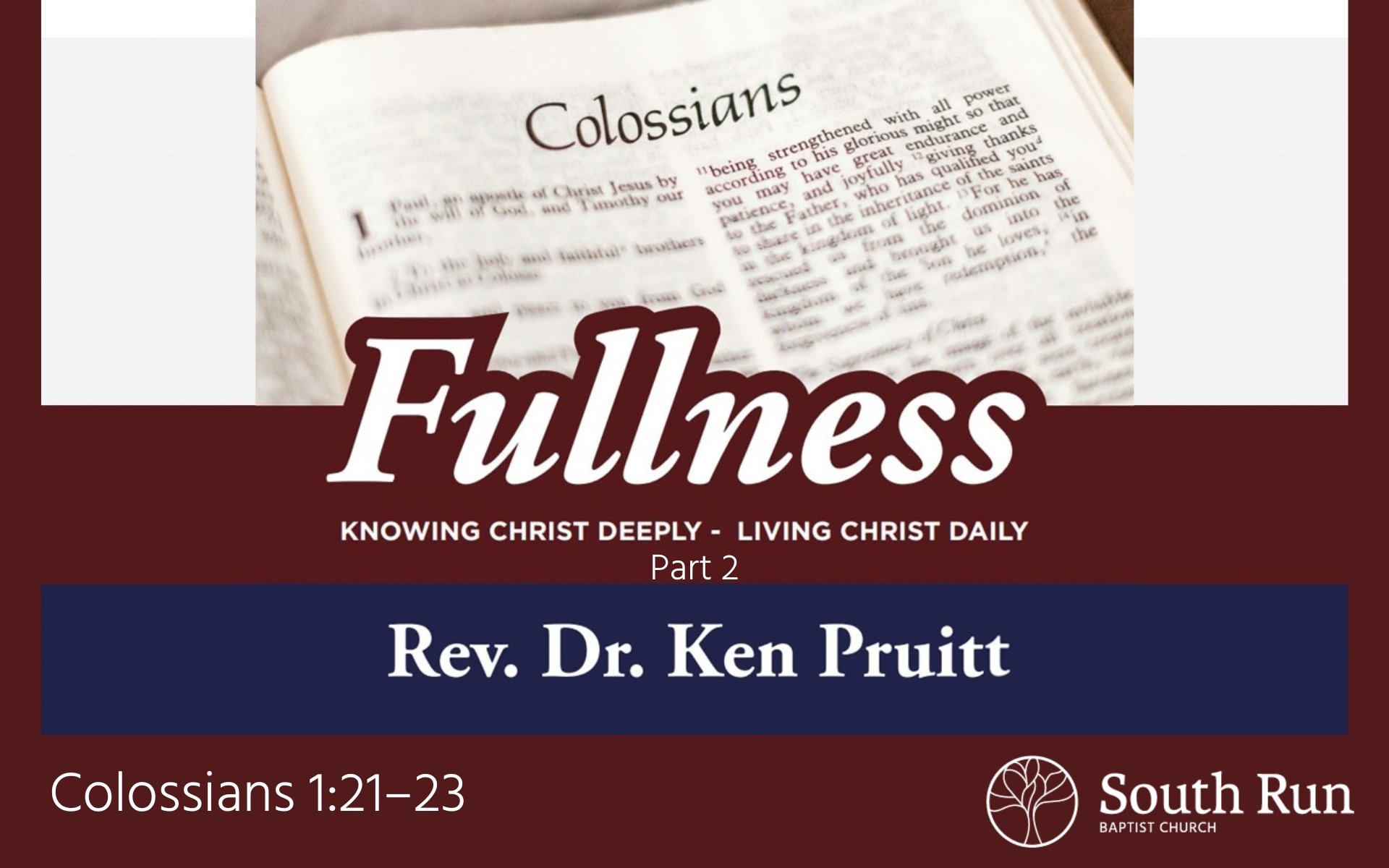
FULLNESS: The Fullness of Christ in Me
Dr. Rev. Ken Pruitt - Guest Pastor
And all God's people said, I am so honored to be with you, South Run Baptist Church. Thank you for your commitment to Jesus, the love you show me and my family each time I'm here. And praise team, musicians, vocalists, thank you so much for how you're bringing honor to Jesus. In this time of worship, my dear friend Eric, man, I love you. I praise God for you. And thank you for entrusting the preaching of the word to to that which God, I believe, desires to do in this moment. I'm honored to be with you, and I invite you to join me where the scripture takes us today to Colossians chapter 1. I'll be reading from chapter 1, verses 18 through 20. Colossians chapter 1, verses 18 through 20. And he, Christ, is the head of the body of the church. He is the beginning and the firstborn from among the dead, so that in everything he might have supremacy. For God was pleased to have all of his fullness dwell in Christ, and through him to reconcile to himself all things, whether things on earth or things in heaven. Did you hear that, church? God in Christ has a desire to reconcile all things to himself. Can you say all things with me? All things. In the Greek that means all things. He's desired to reconcile all things to himself, whether things on earth or things in heaven, by making peace through his blood shed on the cross. Father in heaven, I thank you for the reading of your word. Thank you for the hearts that are receiving. and for your spirit who will instruct us. Father, I certainly desire that the words of man not be understood or any attempt of interpretation of your scripture. But Father, may your Holy Spirit quicken our hearts to hear your word. And we commit this moment to you in Jesus' name. And together we said, amen. Again, so honored to be with you. If you were to look at the screen of my cell phone, you would see a lot of apps. but you'd also see a lot of unused apps. And I'll tell you why. It's this simple phrase, add-ons. A lot of my apps no longer function because I refuse to pay for add-ons. You know what I'm talking about. The app looks promising until it tells you it is not. And I placed this 360 app on my phone recently because we all enjoy keeping up with ourselves and our household. And I wanted to advance a little bit, Eric, so I hit a button. I pushed the button and the app said, oh, no, you don't. You need an add-on. And so the app started pushing my buttons. I'm like, no, I'm not going to do that. spirit of refusing add-ons is remarkably similar to why Paul wrote this letter to the church of Colossae in 62 AD. This congregation was very young. They'd been founded not by Paul, but by one of the young men he had discipled, Epaphras. Paul writes to the church because something dangerous was afoot. There was in their century a problem with add-ons. Although the church in Colossae, the recipient of the letter of Colossians, had placed their trust in Jesus and was following the Christ and was committed to His words, there were voices from without speaking within the church, encouraging that there must be something added to the gospel. Paul said, oh no you don't. And the Holy Spirit raised him up to write this letter that is transferable as a part of God's holy inspired word into our lives today. These voices encourage the church at Colossae to add to their faith in Jesus philosophy, spiritual experiences, even the rites and rituals of the Hebraic tradition. And Paul writes to refute this, to remind them that in Jesus you have all you need. God's salvation for you stands perfect and complete exclusively, not in part, but exclusively in Jesus. And yet these voices continue to say something must be added. This is why in the second chapter of Colossians, you'll hear Paul say, see to it that no one take you captive with hollow philosophies. See to it, Paul would write, that no one deceive you with hollow philosophies that will bring in man's truth in an attempt to combine with the gospel to present something that is most assuredly not the gospel. This happens today, does it not? If we spend just a moment in some form of a media platform, we will see that there are truths that attempt to delude and to mix in with the Christian faith. This is happening in the 1st century. This was a young congregation, so Paul was quite concerned that some might buy into this early development of what is now known as Gnosticism, meaning that there are special revelations that can only come from God, not through Jesus, because matter is evil. Only spiritual things are holy. And so the incarnate God in Christ was dismissed, and many other heresies came out of this moment in history. Paul wrote to them about the fullness of Jesus. In fact, you and I can understand Paul's heart behind this letter by looking at something he prayed in chapter 1, verse 9. In that verse, Paul wrote and literally prayed, we continue to ask God to fill you with a knowledge of His will. What is that knowledge of the will of God that would keep you and me from being pulled into deceptive voices of vain philosophies and other teachings that are against the gospel. What is this full knowledge of the will of God? This is a bit more transcendent. In fact, it is way more transcendent than how you and I might think of knowing the will of God. We at times will seek God's will for where we will attend college or what career may be ours or who we will marry. Those are the big life episodes wherein we will sometimes say, God, I want to know your will. That's not at all the categories from which Paul says, oh, I pray, church of Colossae, that you will be filled with the knowledge of God's will. Here the idea of God's will is much more transcendent. And to better understand this, it's always important to allow the whole of the scripture to be our commentary for one specific scripture. And there is a partnering verse here that will help you and me to understand why of all the things Paul could have prayed for this church that was being hit by heresies, why Paul would pray, oh, that you would have full knowledge of the will of God. What is that will of God referenced here? Well, a partnering passage in Ephesians chapter 1, verse 9 and 10, Paul writes that the mystery of God's will, he has the word mystery there, the mystery of God's will has been revealed, and then Paul names it, that all things will be brought under one head, Jesus Christ. So when Paul prays for the Colossian church that they would be full of the knowledge of God's will, He's praying that they would have a deep, a full, a complete understanding of all that God has accomplished for them through Jesus. Paul writes, I pray that you'll be filled with understanding what God has done for you in Christ. Now immediately, you and I, especially those of us who've been in church since the day we were able to take our first breath, will quickly say, well, Ken, I know the gospel. I've heard the gospel. I could reiterate the gospel. So why would I need to know more, have the full knowledge of a gospel that I've already heard all my life? Well, your question, if that would be your question, makes the apostle Paul's point. And it makes the teaching of the Holy Spirit's point here very clear. Paul is not saying that you would have a recognition of the gospel so that you can recite it. Paul is not saying that you have some cerebral understanding of the gospel. Paul writes that you would have a full knowledge and experience that you would truly know the fullness and the essence of Jesus. Here lies more than simply an idea or a truth that we hear about and try to respond to. This is looking at Jesus and seeing him for the fullness of who he is so that our lives are responding to him. There is a formula of this, knowing the truth and responding as far back as Psalm chapter 89. In that Psalm, the Psalmist said, God, please teach me your ways so that I may respond to your faithfulness. Paul writes in that same formulae to the Colossian church, oh that you may know the fullness of Christ so that your lives will respond to who he is in all of his glory, in the vastness of who he is as the reigning King of Kings and as the one who died to redeem us. And so Paul does this for a specific purpose, to lead Colossians away from those deceptive philosophies. And how does Paul do that? By focusing upon the Christ. Last week as we were together in God's Word, I shared with you as many as five marks of the true essence of Jesus brought out here so that we might more fully understand the Christ and not give in to those dangerous add-ons. And what did we discover? We discovered that Jesus is indeed the exact image of God, that He is supreme over all realms, and that He's head of the church. But we pick up with that 4th mark in verse 18. He is the firstborn from among the dead. Of all of these amazing and powerful demonstrations of the true identity of Jesus, we hear The scripture pronounced powerfully, he's the firstborn from among the dead. He has power over dead. If there was any question that the heresies would bring to the minds of the Colossians, those questions should have been erased. dismiss completely learning that Jesus has actually conquered everything that would separate us from God, including the grave, including death. He is the firstborn from the dead. Now, if you and I were to walk our way through the scriptures together, we would discover in that chronological reading as many as 9 to 10 stories about people being raised from the dead. Yet each one gives the narrative of their life resurrection being followed by immediately dying again. They were resurrected because of sin or some injurious thing, and yet they would be resurrected to die again. Only one has been resurrected never to die, and his name is Jesus. That's why he is held here in all of scripture as the firstborn among the dead. This is why Revelation chapter 1, verse 18 announces clearly that he holds the keys of death and the grave. You know, someone holds the keys, they're pretty much in charge, so we think. That was the vernacular and that was the intimation of Paul's words and of the words in Revelation. He holds the keys. He controls, he has defeated death and the grave. But also look at a final mark here, emphasizing the greatness of Christ so that we look to Him and are not swayed to the need for an add-on. That we look to Christ so that we're not saying it's Jesus plus. ceremony. It's Jesus plus special revelation. It's Jesus plus ascetic behavior of denying my body certain pleasures. Or it's Jesus plus man-made ceremonies or rudimentary principles that will eventually trap us in darkness. No, it's Jesus only. And Paul concludes this amazing hymn-like paragraph from the scriptures describing the essence of Jesus in its fullness And he ends by these very powerful words in verse 19 and 20. For it was God who was pleased to have all of his fullness dwell in him. Focus on verse 19. We will find reason why these verses are so important to push away false beliefs both then and now. For God was pleased to have all the fullness dwell in him and through him to reconcile to himself all things, whether things on earth or things in heaven. This is Paul's language, things on earth in heaven, not referencing our home heaven, but referencing every possible part of the created existence, the heavens and the earth, all things. There's nothing here that will not be touched by the power of Jesus giving us the opportunity through our faith in Him to be reconciled to God. And all of this, is done because Jesus has made peace through his blood shed on the cross. Absolute in redemption. That's our Jesus. There's nothing missing. Only in Christ can mankind truly know God. This is Paul's message. It seems simple to you and me. We've heard this The entire existence of our life, at least some of us have, and yet here it becomes so profound in the face of our tendencies to welcome add-ons to our faith. And Paul writes, it's only in Christ. It was that great preacher, Charles Spurgeon, perhaps you've heard his name quoted once or twice before, who said this when asked if he had a creed. And Spurgeon said, If I'm asked if I have a creed, the answer is I have but one, and it's Jesus Christ. And then Spurgeon went on to elaborate because he is the sum and substance of the gospel. He is all theology. And he is the incarnation of every precious truth. This becomes the heart of what Paul desired that the church at Colossae see, the fullness of the Christ. And then in this first chapter of this amazing letter, Paul gently but very pastorally carries the Colossians' attention from fullness in Christ to that great application, fullness in Christ in me. What does it look like for you and I to live in the reality of the fullness of Christ in me? We pick up at verse 21. Once you were alienated from God and you were enemies in your minds because of your evil behavior. But now he has reconciled you, he meaning God, has reconciled you by Christ's physical body through death to present you wholly in his sight without blemish and free from accusation. Paul seems to bring into the idea of how you and I are complete in Christ and the fullness of Christ dwells in us through the Spirit, first by pointing to the past. He will in a moment point to the present and the future. But he points to the past, and I believe the focus here can be clearly in the past on the crucifixion. Notice what Paul writes here. Once you were alienated from God and were enemies in your minds because of your evil behavior, this enmity from the very beginning when sin entered this earth, can only become something that is removed because of Jesus. We know this. We know that Romans chapter 5 talks about the first Adam and sin comes in, but then compares Christ like a second Adam, not fully a man, but fully God and fully man, bringing in our salvation completely to remove the curse of sin. And Paul wrote, you were alienated from God. You were enemies in your mind, but But he's reconciled you how? Through Christ, physical body, through death. Therein lies the past tense of Paul's emphasis upon the completeness of our salvation. The past, Christ was crucified. Why would Paul add in body? Why would he mention the physical here because the heresies, particular the beginning seeds of what would become full-blown Gnosticism, held high the perfect holiness of what is spiritual, but denied that God would redeem anything physical or material. And so Paul argues that beautifully and conclusively God in Christ went to the cross to redeem us. Church, I ask you, Do you not desire that it would be your testimony in mine to be like that of Paul's when in Romans chapter 6 verse 6, in Galatians chapter 5 verse 24, in Galatians chapter 6 verse 14, Paul over and over again said, I am crucified with Christ. He articulated that in Galatians chapter 2 and verse 20. Each of those verses have something powerful in common along with the word crucified. It is the tense of the word. The grammarian in Greek would call it the aorist. It is the completed action never to be acted upon again. Paul wrote, I'm crucified with Christ. I laid my old self down and I have been raised to a new life. in Christ and I fear that today in the church at large, many are struggling to let go of the identity of a sinful past because in our minds we think we must do something. that will give us a true essence of God's being pleased with us when scripture says it is impossible for us to do that without the grace of the cross. But I fear many people are held in the clutches of that guilt where we do not feel good enough. And Paul writes, we have been crucified. That's been done in the past. What Christ did on the cross and then through the empty grave and now ascended on high, is enough. It's complete for you to be fully redeemed. This is the fullness of Christ in us. But look at the present tense. Paul writes, but now he has reconciled you. You've been brought together with him. This is present tense. The actual tense in that verse is now you are reconciled through Christ to God. Second Corinthians 5, In verse 19, that announces God in Christ reconciling the world to himself. And then future tense, from the crucifixion to reconciliation to this powerful statement, God presenting us. Do you see that? How powerful God presenting us. Free from accusation, without blemish. This is the future reference of salvation that Paul articulates here, that on that day you'll be presented to God without blemish. He's made us right with Jesus. through the death and resurrection. He's reconciled us in the present. He's making us right. And He makes us right eternally for the future as He presents us wholly before God. And on that day that our breathing stops here and our eyes awaken there, we will be presented perfect, fully as Christ has died to make us perfect. And this becomes a powerful recognition of how you and I live on these truths of the fullness of Christ in me. The fullness of Christ, the image of God, supreme over all spheres, head of the church, the fullness of Christ, in all of the glory of God, being absolute in redemption, the fullness of Christ in me. He died on the cross that I might say I'm counted as crucified with Him. He's reconciled me to God now. Nothing can break that, and He's presenting me holy and blameless when I stand with Him. in heaven what a beautiful picture of the fullness of Christ and the fullness of Christ in you and me there was a young man in 16th century Germany who wrestled significantly with the idea of being pleasing to God He read the scriptures but would see phrases like the righteousness of God as only punitive, interpreting that God's righteousness is actually that which punishes the sinner. And this young man felt the guilt as a sinner. So he attempted many acts of what he would call acts toward righteousness. He prayed relentlessly. He confessed rigorously. He fasted severely, even to the point of fainting, with a desire to somehow taste what it's like to be right with God. But nothing worked. This young man, over many series of prayer and before the scripture, saw that phrase, the righteous will live by faith. And his life became changed. He confessed Jesus as his Lord. And you have probably guessed who this young man in 16th century Germany is, Martin Luther. And this is what he said, this is actually what he wrote looking back on his conversion. It was like walking through a gate into paradise where I'm truly free in Christ. So today, from the bottom of my heart, I ask, can you say of your place with Jesus that you feel free, like you have walked through a gate and you're free in Christ to know who He is and to know who you are and what He's done for you. so that you can have a life that is free to worship, not perfect, but free to worship, free to live for Him, free to have a desire to honor Him and to fulfill what He directs us to do as we follow after Him. Oh, I pray that you will have that freedom. And I pray that in just a moment as we come to the table of observing what our Savior has done, that when you allow the observance of the Lord's table to affect your sight and your senses and your taste, as you partake of the bread and the cup, would you allow the amazing truth of Jesus to wash over you? And I desire to do the same so that we leave this place knowing full well that we are going to respond to Jesus for who He is. and for who he is in us as we desire to live for him. Amen, church. Would you pray with me? Father in heaven, thank you for your word speaking to our hearts. And now, Father, as we come to your table, we do so, Father, not tritely, not out of routine or habit. Oh, Father, forbid that we would come simply because this is just another step, but oh, Father, may we come anticipating a renewed sense of who you are and what you've accomplished as we live for you Father we pray this we offer this in the precious name of Jesus our Lord and together we said amen